
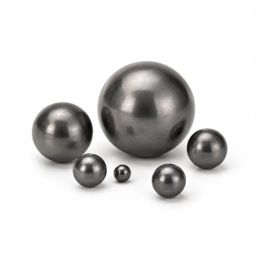
Tantalum Balls – High-Purity Corrosion-Resistant Tantalum Spheres
Tantalum balls are dense, high-purity refractory-metal spheres selected for exceptional chemical stability, a very high melting point and demanding purity requirements. SDBALLS supplies tantalum spheres for semiconductor equipment, chemical processing, electronics, aerospace, laboratory and other advanced engineering programs. Final suitability depends on the exact medium, temperature, pressure, purity, cleanliness and inspection requirements.
| Article | Contenu de page recommandé |
| Nom du produit | High-purity tantalum balls and spheres |
| Matériel | Tantalum Ta, 99.95% typical |
| Plage de diamètres | 0.5-100 mm; subject to material and production review |
| Tolérance | +/-0.01 mm typical project reference; drawing-defined requirements by review |
| Densité | Approximately 16.6 g/cm3 |
| Applications typiques | Semiconductor, chemical processing, electronics, aerospace and research |
Partager ce produit
Présentation du produit
Tantalum forms a stable passive oxide film that provides outstanding resistance to many aggressive chemical environments. Its density and refractory-metal stability also support compact-mass, high-temperature, vacuum and high-value engineered applications.
Buyers should define purity, diameter, tolerance, roundness, finish, cleanliness, material certificate and any third-party testing before quotation. Tantalum should not be approved from a generic corrosion statement alone; exact media and service conditions must be reviewed.
Material Selection and Technical Positioning
- Choose tantalum when chemical inertness, high density, refractory-metal stability or high-purity electronic compatibility justify its premium material cost.
- Compared with titanium, tantalum is much denser and can provide stronger resistance in selected aggressive media, but it is heavier and more expensive.
- Compared with niobium, tantalum is denser and is often selected for chemical and electronic applications rather than superconducting systems.
- Compared with tungsten alloys, tantalum offers different corrosion, purity and thermal properties and must not be treated as a direct density-only substitute.
Spécifications techniques
The values below are product-family references. The quotation, drawing, agreed standard and inspection plan control the final supply specification.
| Paramètre | Typical SDBALLS Supply Range or Note |
| Matériel | Tantalum Ta |
| Purity | 99.95% typical; higher-purity projects by review |
| Diamètre | 0.5-100 mm; purity and production-route dependent |
| Tolérance de diamètre | +/-0.01 mm typical reference; final tolerance by drawing |
| Rondeur | Application-specific; confirm before quotation |
| Dureté | Condition dependent; confirm annealed, worked or project-specific state |
| Densité | Approximately 16.6 g/cm3 |
| Melting Point | Approximately 3017 C |
| Magnetic Behaviour | Non-ferromagnetic |
| Finition de surface | Machined, ground, lapped, polished or mirror finish by agreement |
| Résistance chimique | Excellent in many media; verify fluid, concentration, temperature and exposure |
| Reference Standards | ASTM B365; ASTM F560 when applicable to a qualified medical program |
| Emballage | Clean vials, trays, sealed bags, cartons or custom protective packs |
Applications and Application Fit
Application names are selection guides, not universal approval. Confirm the actual load, media, temperature, pressure, service life and compliance requirements.
| Application | Pourquoi cela convient | Remarque pour l'acheteur |
| Semiconductor equipment | High-purity process, vacuum and contamination-controlled components | Define cleanliness and analytical evidence |
| traitement chimique | Spheres for corrosion-sensitive process equipment | Confirm chemical, concentration, temperature and pressure |
| Électronique | Tantalum-based high-value electronic and capacitor-related programs | Define purity, traceability and electrical function |
| Aerospace and research | Dense refractory spheres for thermal, mass and laboratory functions | Validate load, temperature and environment |
| Medical programs | Biomaterial projects requiring controlled tantalum | Device-specific validation and regulatory approval required |
Guide de sélection des matériaux
| Option de matériau | Primary Advantage | Limitation | Typical Fit |
| Tantalum | Exceptional chemical stability, density and refractory performance | Premium raw-material and machining cost | Semiconductor, chemical and electronic systems |
| Niobium | Superconducting capability and lower density | Different corrosion and electronic behaviour | MRI, accelerators and scientific programs |
| Titanium | Low density, corrosion resistance and strength-to-weight ratio | Lower density and different chemical compatibility | Marine, medical, chemical and aerospace systems |
| Tungsten alloy | Very high density and compact mass | Different corrosion and purity characteristics | Balancing, counterweight and impact applications |
Manufacturing and Process Control
The production route is selected according to purity, size, quantity and tolerance and may include billet or rod preparation, precision machining, grinding, lapping, polishing, controlled cleaning and inspection. Clean handling and lot separation are required when contamination limits or high-purity documentation apply.
Quality Control and Inspection
- Material certificate and purity verification
- Diameter, tolerance and sphericity inspection
- Surface finish and cleanliness inspection
- Lot identification and traceability
- Chemical composition or purity report when agreed
- Third-party testing support by prior agreement
- Final packing inspection
Options d'emballage
Use clean, non-contaminating vials, trays, sealed bags, cartons or customer-specified protective packs. Separate precision pieces to prevent contact damage when surface or geometry is critical. Do not reuse the copper-alloy anti-tarnish wording from other product templates.
Comment spécifier pour un devis
Ask the buyer to provide the following information so the sales and engineering teams can confirm the correct material and production route.
- Tantalum purity or governing material standard
- Diamètre et tolérance
- Roundness or sphericity requirement
- Surface finish and roughness, if specified
- Quantity and forecast
- Chemical medium and service conditions
- Cleanliness and contamination limits
- Certificates, inspection plan, packing and destination
FAQ technique
Q What purity is available for tantalum balls?
A Tantalum at 99.95% purity is a typical reference. Higher-purity requirements must state the analytical method and certificate expectations.
Q What size and tolerance can SDBALLS supply?
A The reference range is 0.5-100 mm with +/-0.01 mm as a typical project tolerance. Actual capability depends on purity, size, quantity and finish.
Q Are tantalum balls corrosion resistant?
A Tantalum resists many aggressive media, but compatibility must be checked against the exact chemical, concentration, temperature, pressure and exposure time.
Q Can polished or mirror-finish tantalum spheres be supplied?
A Machined, ground, lapped, polished and mirror-finish requirements can be reviewed with measurable surface and visual criteria.
Q Can SDBALLS provide material certificates?
A Yes, when the certificate type, purity, test method, sampling plan and report format are confirmed before quotation.
Q Are small quantities available?
A Prototype, qualification and small-batch enquiries can be reviewed subject to material, size and production availability.
Produits associés
Demande de planification
Contactez-nous dès aujourd'hui pour toute demande de service. (*) Indique les champs obligatoires.