
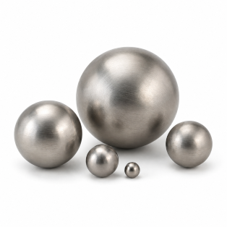
Titanium Balls – Grade 1 Grade 2 and Grade 5 Titanium Spheres
Titanium balls combine low density, a high strength-to-weight ratio, corrosion resistance and non-ferromagnetic behaviour. SDBALLS supplies commercially pure Grade 1 and Grade 2 titanium spheres and high-strength Grade 5 Ti-6Al-4V balls for chemical valves, pumps, marine equipment, aerospace, medical and special industrial applications. The correct grade must be selected from the actual load, medium, temperature, wear and qualification requirements.
| Article | Contenu de page recommandé |
| Nom du produit | Titanium precision balls and spheres |
| Qualités des matériaux | Commercially pure Grade 1 / Grade 2; Grade 5 Ti-6Al-4V |
| Plage de diamètres | 0.5-100 mm; grade and production-route dependent |
| Tolérance | +/-0.01 mm typical project reference; final value by drawing |
| Densité | Approximately 4.5 g/cm3, grade dependent |
| Applications typiques | Chemical valves and pumps, marine, aerospace, medical and engineered components |
Partager ce produit
Présentation du produit
Grade 1 and Grade 2 commercially pure titanium emphasize corrosion resistance and formability. Grade 5 Ti-6Al-4V provides substantially higher strength for structural and aerospace duties. These grades are not interchangeable without application review.
Titanium is selected when steel is too heavy, corrosion-prone or magnetically unsuitable. Final approval must consider galling, wear, seat material, fluid chemistry, crevice conditions, surface finish and any medical or aerospace qualification rules.
Material Selection and Technical Positioning
- Grade 1 provides high ductility and strong corrosion resistance for forming-sensitive, chemical and marine applications.
- Grade 2 provides a widely used balance of strength, formability, corrosion resistance and biocompatibility.
- Grade 5 Ti-6Al-4V provides much higher strength-to-weight performance for demanding structural and aerospace components.
- Compared with stainless steel, titanium is lighter and non-ferromagnetic, but material cost, wear behaviour and manufacturing route differ.
Spécifications techniques
The values below are product-family references. The quotation, drawing, agreed standard and inspection plan control the final supply specification.
| Paramètre | Typical SDBALLS Supply Range or Note |
| Matériel | Titanium / titanium alloy |
| Notes | Grade 1 / Grade 2 / Grade 5 Ti-6Al-4V |
| Diamètre | 0.5-100 mm; grade and production-route dependent |
| Tolérance de diamètre | +/-0.01 mm typical reference; drawing-defined values by review |
| Rondeur | Application-specific; confirm before quotation |
| Dureté | Grade, heat treatment and condition dependent |
| Densité | Approximately 4.5 g/cm3; grade dependent |
| Melting Point | Approximately 1668 C |
| Magnetic Behaviour | Non-ferromagnetic |
| Finition de surface | Machined, ground, lapped, polished, passivated or cleaned by agreement |
| résistance à la corrosion | Excellent in many marine and chemical environments; exact compatibility must be checked |
| Biocompatibility | Useful characteristic; medical use requires grade-specific and device-specific validation |
| Emballage | Clean bags, vials, trays, cartons or custom protective packs |
Applications and Application Fit
Application names are selection guides, not universal approval. Confirm the actual load, media, temperature, pressure, service life and compliance requirements.
| Application | Pourquoi cela convient | Remarque pour l'acheteur |
| Chemical valves and pumps | Flow-control parts selected for corrosion resistance and low mass | Check media, pressure, seat design and wear |
| Marine equipment | Seawater and coastal systems | Review crevice conditions and actual chemistry |
| Aérospatial | Low-mass, high-strength mechanisms and assemblies | Specify grade, condition and qualification standard |
| Équipement médical | Non-ferromagnetic and biocompatibility-led components | Device-specific material and regulatory validation required |
| Precision engineering | Special mechanisms where weight and corrosion matter | Confirm tolerances, surface and contact wear |
Guide de sélection des matériaux
| Option de matériau | Primary Advantage | Limitation | Typical Fit |
| Titanium Grade 1 / 2 | Corrosion resistance, formability and low density | Lower strength than Grade 5 | Chemical, marine and medical duties |
| Grade 5 Ti-6Al-4V | High strength-to-weight ratio | Different corrosion, wear and medical considerations | Aerospace and high-strength components |
| AISI 316 / 316L | Established corrosion-resistant stainless supply | Heavier and potentially magnetic after processing | Valves, pumps and hygienic systems |
| Tantalum | High density and exceptional resistance in selected aggressive media | Much heavier and more expensive | Chemical, semiconductor and electronic applications |
| Aluminium | Very low density and lower cost | Lower strength and different corrosion behaviour | Light-duty and decorative applications |
Manufacturing and Process Control
Depending on grade, diameter and tolerance, the route may include bar or billet preparation, precision machining, grinding, lapping, polishing, cleaning and inspection. Grade identity, heat or lot traceability and surface condition must remain controlled throughout production.
Quality Control and Inspection
- Grade and material-certificate verification
- Diameter, tolerance and roundness inspection
- Surface finish and visual inspection
- Hardness or mechanical evidence when specified
- Batch identification and traceability
- Cleanliness and packing inspection
- Third-party testing support by agreement
Options d'emballage
Use clean bags, vials, trays, cartons or custom protective packs based on size, surface sensitivity, quantity and destination. Precision or cosmetic spheres should be separated or cushioned to reduce contact marks during transport.
Comment spécifier pour un devis
Ask the buyer to provide the following information so the sales and engineering teams can confirm the correct material and production route.
- Titanium grade and governing standard
- Diamètre et tolérance
- Roundness or sphericity
- Surface finish, roughness and cleanliness
- Quantity and forecast
- Application, load and contact conditions
- Fluid chemistry, temperature and pressure
- Certificates, testing, packing and destination
FAQ technique
Q Which titanium grades are available?
A Common options include commercially pure Grade 1 and Grade 2 and high-strength Grade 5 Ti-6Al-4V. Other grades can be reviewed.
Q What is the difference between Grade 2 and Grade 5?
A Grade 2 emphasizes corrosion resistance and ductility, while Grade 5 provides much higher strength. They are not interchangeable without engineering review.
Q Are titanium balls suitable for seawater?
A Titanium performs well in seawater and many chemical environments, but alloy, crevice conditions, temperature and complete service chemistry must be checked.
Q Can titanium balls be used in medical devices?
A Titanium is widely used in medical applications, but the correct grade, traceability, finish, cleanliness and device-specific regulatory validation are required.
Q What size and tolerance are available?
A The reference range is 0.5-100 mm with +/-0.01 mm as a typical project tolerance. Actual capability depends on grade, size, finish and quantity.
Q What documents can be supplied?
A Material certificates, dimensional reports, traceability and agreed third-party testing can be planned when requirements are defined before quotation.
Produits associés
Demande de planification
Contactez-nous dès aujourd'hui pour toute demande de service. (*) Indique les champs obligatoires.