G10 vs G100 vs G1000 Steel Balls: How to Choose the Right Grade
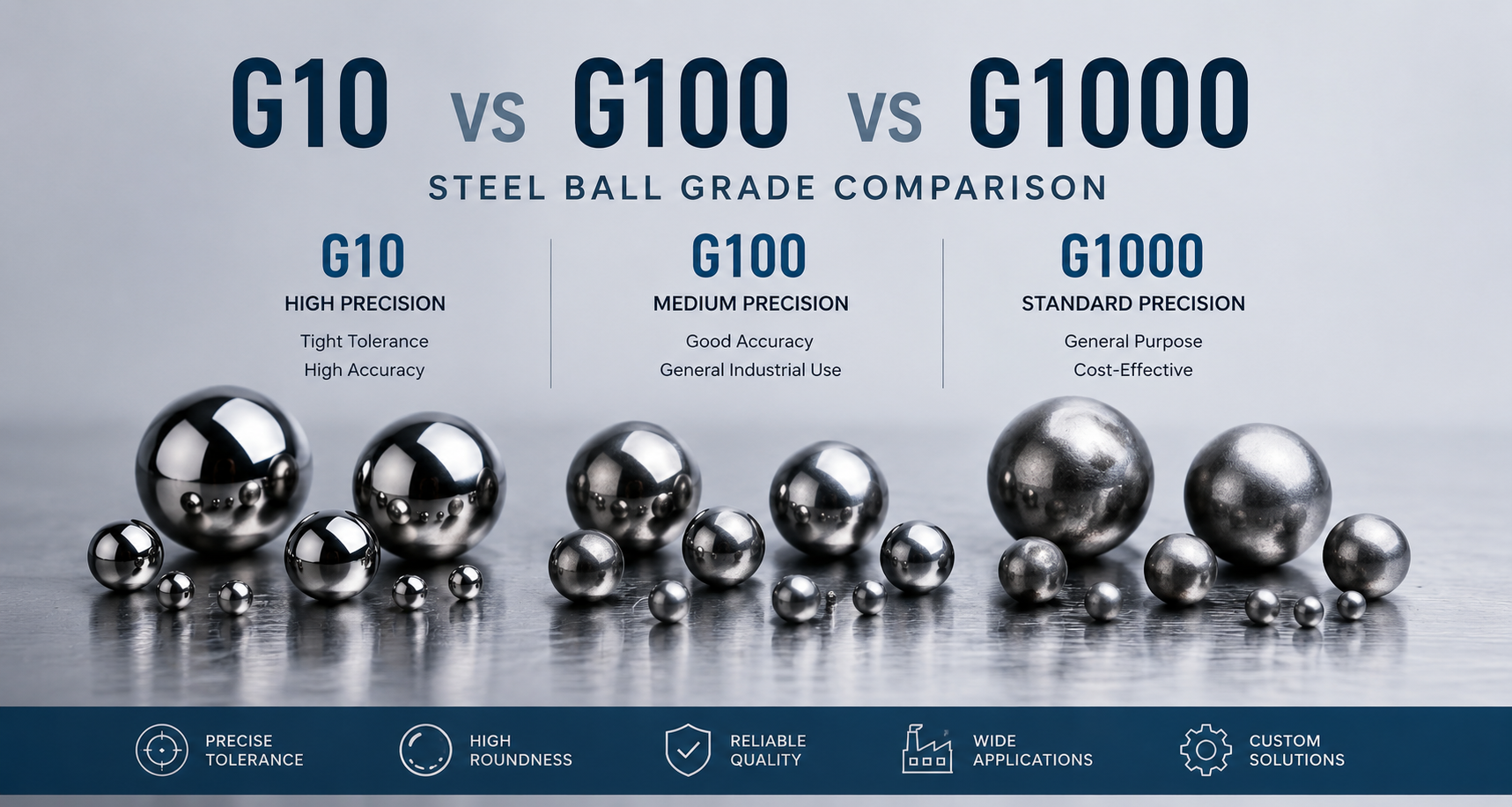
How to Choose the Right Grade
Choosing the right steel ball is not only about selecting the correct diameter and material.
For many industrial applications, steel ball grade is equally important because it describes the precision level of the ball and affects dimensional consistency, roundness, surface quality and overall performance.
Industrial buyers commonly encounter specifications such as G10, G100 and G1000. While a lower grade number generally represents a higher precision level, the highest precision is not always the best or most economical choice for every application.
The right grade depends on how the ball will actually be used.
This guide explains the practical differences between G10, G100 and G1000 steel balls and what buyers should consider before requesting a quotation.
What Does Steel Ball Grade Mean?
Steel ball grade is a classification used to define the precision level of a finished ball.
It is related to factors such as:
- dimensional consistency
- spherical accuracy
- diameter variation
- surface condition
- manufacturing precision
In general:
The lower the grade number, the higher the precision level.
For example, a G10 ball is manufactured to a significantly higher precision level than a G1000 ball.
However, grade should never be considered alone.
A suitable steel ball specification normally combines:
material + diameter + grade + hardness + surface condition + application requirements
For this reason, two balls of the same diameter may perform very differently if their materials, grades or heat-treatment conditions are different.
What Are G10 Steel Balls?
G10 steel balls belong to the higher-precision range of industrial steel balls.
They are commonly selected when dimensional consistency, spherical accuracy and reliable rolling or contact performance are important.
Typical applications may include:
- precision bearings
- high-precision mechanical assemblies
- automotive components
- motion-control systems
- measuring equipment
- precision valves
- instruments
- other engineered mechanisms requiring tight ball consistency
Producing a high-precision ball generally requires additional manufacturing, grinding, lapping, inspection and quality-control processes.
Therefore, G10 should normally be selected when the application genuinely requires this level of precision.
Specifying a higher grade than necessary can increase manufacturing cost without improving the performance of the final product.
What Are G100 Steel Balls?
G100 steel balls are widely used across industrial applications that require good dimensional consistency but do not necessarily require the highest bearing-level precision.
Typical applications may include:
- industrial machinery
- mechanical assemblies
- valves
- hardware
- ball transfer systems
- selected bearing applications
- automotive components
- OEM products
For many industrial buyers, G100 provides a practical balance between precision, manufacturing capability and cost.
When comparing G10 and G100, the key question should not simply be:
“Which grade is better?”
A more useful question is:
“What level of precision does my application actually require?”
If the product does not depend on extremely tight dimensional consistency or precision rolling performance, G100 may provide a more appropriate and economical solution.
What Are G1000 Steel Balls?
G1000 steel balls are generally used in applications where extremely high dimensional precision is not required.
Depending on the material and ball size, they may be suitable for:
- general mechanical applications
- hardware products
- positioning functions
- mixing applications
- weighting applications
- consumer products
- decorative uses
- general industrial components
In these applications, factors such as material, corrosion resistance, hardness, size and cost may be more important than very tight spherical accuracy.
G1000 can therefore be an economical solution when the ball is performing a general mechanical or functional role rather than acting as a high-precision rolling element.
G10 vs G100 vs G1000: What Is the Main Difference?
The main difference is the required level of precision.
G10
Best suited to applications where high dimensional consistency and precision performance are critical.
G100
Suitable for many industrial applications requiring reliable and controlled ball quality without the cost of the highest precision grades.
G1000
Suitable for general industrial applications where broader dimensional tolerances are acceptable.
The correct choice depends on the engineering function of the ball rather than the grade number alone.
When Should You Choose a Higher-Precision Steel Ball?
A higher precision grade may be necessary when:
- the ball operates inside a precision bearing
- dimensional variation must be tightly controlled
- smooth rolling performance is critical
- vibration or noise must be minimized
- the engineering drawing specifies a particular grade
- multiple balls must maintain very consistent dimensions
- the ball forms part of a precision mechanical assembly
In these cases, precision directly affects the performance of the finished component.
When Is a Lower Precision Grade More Appropriate?
A commercial or lower-precision grade may be more suitable when:
- extremely tight tolerance is unnecessary
- the ball performs a general mechanical function
- the application does not depend on precision rolling
- cost control is important
- the ball is used for positioning, weight, mixing or general movement
- dimensional requirements allow greater variation
Choosing an unnecessarily high grade can increase product cost without producing a meaningful performance benefit.
For OEM buyers, selecting the appropriate grade rather than simply the highest grade is therefore an important part of cost and specification control.
Material Is Just as Important as Ball Grade
Steel ball grade tells only part of the story.
The ball material also determines characteristics such as hardness, wear resistance, corrosion resistance and suitability for different operating environments.
Kulki ze stali chromowej
https://sdballs.com/products/chrome-steel-balls/
Chrome steel balls are commonly selected for applications requiring high hardness, wear resistance and precision performance.
AISI 52100 chrome steel is widely used in bearing and mechanical applications.
Kulki ze stali nierdzewnej
https://sdballs.com/products/stainless-steel-ball/
Stainless steel balls are often selected when corrosion resistance or environmental compatibility is important.
Different stainless steel grades provide different combinations of hardness and corrosion resistance.
For example, hardened martensitic stainless steels are often selected when wear resistance and mechanical strength are important, while austenitic stainless steels are frequently selected for applications where corrosion resistance is the priority.
Kulki ze stali węglowej
https://sdballs.com/products/carbon-steel-ball/
Carbon steel balls are widely used in general industrial and mechanical applications.
They can provide a cost-effective solution when extreme corrosion resistance or very high precision is not required.
Therefore, the final specification should always consider:
grade + material + diameter + hardness + surface finish + working environment
Does Every Material Offer the Same Precision Grades?
Nie.
Available precision grades depend on the material, diameter, manufacturing process and technical requirements.
Not every material can economically or technically be produced to every grade.
For example, high-precision hardened steel balls may be available in significantly tighter grades than some softer, non-hardened or special-material balls.
This is why buyers should not assume that a grade available in one material will automatically be available in another.
The manufacturer should confirm feasibility based on the complete specification.
What Information Should Buyers Send When Requesting Steel Balls?
A complete inquiry helps the manufacturer evaluate the requirement quickly and accurately.
Whenever possible, provide:
- Średnica kuli
- Tworzywo
- Required grade
- Ilość
- Wymagania dotyczące twardości
- Surface finish or coating
- Aplikacja
- Operating environment
- Drawing or technical specification
- Annual consumption for production projects
If the exact steel ball grade is unknown, buyers can simply describe the application and performance requirement.
An experienced ball manufacturer can then recommend an appropriate starting specification.
Avoid Over-Specifying Your Steel Balls
One common purchasing mistake is automatically selecting the highest available precision grade.
Higher precision normally requires more manufacturing and inspection processes and can increase the final cost.
If the application only requires a general industrial ball, specifying G10 instead of G100 or G1000 may offer little practical advantage.
At the same time, choosing a grade that is too low for a precision mechanism can result in inconsistent performance.
The best specification is therefore not necessarily the highest grade.
It is the grade that matches the actual engineering requirement.
How SDBALLS Helps Industrial Buyers Select the Right Ball
SDBALLS supplies steel balls for precision, industrial and custom applications.
Available solutions include:
- Kulki ze stali chromowej https://sdballs.com/product/aisi-52100-chrome-steel-balls/
- Kulki ze stali nierdzewnej https://sdballs.com/products/stainless-steel-ball/
- Kulki ze stali węglowej https://sdballs.com/products/carbon-steel-ball/
- Precyzyjne stalowe kulki https://sdballs.com/product/
- Special Material Balls https://sdballs.com/products/special-product/
- Custom and Engineered Ball Solutions https://sdballs.com/applications/
Ball specifications can be evaluated according to material, diameter, grade, hardness, surface condition, quantity and application requirements.
For projects where buyers are uncertain about the correct grade, SDBALLS can review the application requirements and help identify a suitable ball specification before quotation.
Request a Steel Ball Recommendation
Not sure whether your application requires G10, G100 or G1000?
Send SDBALLS the following information:
Material + Diameter + Grade Requirement + Quantity + Application
If the exact grade is unknown, simply provide the application or technical drawing.
Our team can help evaluate the appropriate steel ball solution for your project.

O autorze
Jesteśmy firmą SD Ball, profesjonalnym producentem specjalizującym się w dostarczaniu precyzyjnych rozwiązań w zakresie kul stalowych na całym świecie. Dzięki wieloletniemu doświadczeniu specjalizujemy się w zaawansowanych procesach produkcyjnych, ścisłej kontroli jakości oraz dostosowanych rozwiązaniach, wspierających różnorodne zastosowania przemysłowe. Od doboru materiałów po kontrolę końcową, zapewniamy niezawodne produkty i stałą wydajność, pomagając naszym klientom osiągnąć wyższą wydajność, trwałość i jakość produktu.
Udział
Kategoria produktu
Powiązane artykuły
-
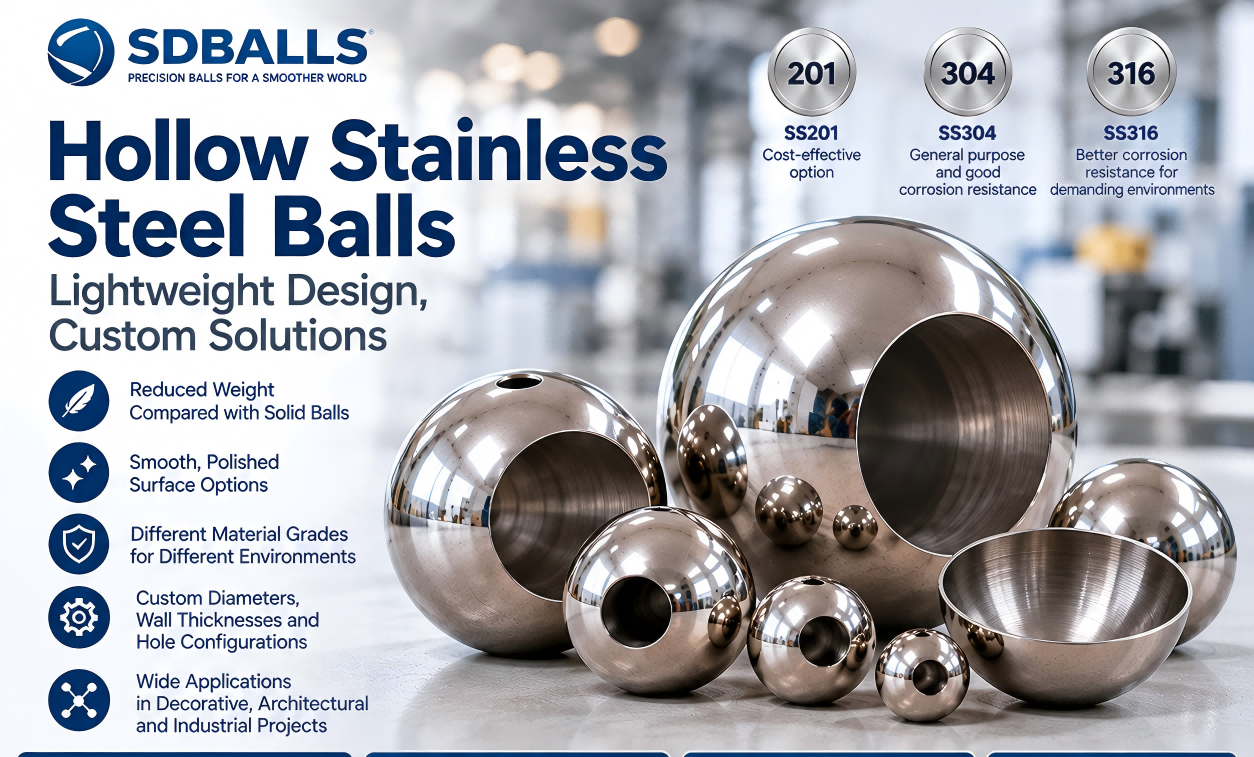
Hollow Stainless Steel Balls: Materials, Sizes, Wall Thickness and Applications
Hollow stainless steel balls are widely used in architectural decoration, metal fabrication, furniture components, and industrial assemblies. Their hollow structure provides a practical way to reduce component weight while maintaining a spherical appearance. At SDBALLS, we supply hollow stainless steel spheres in different materials, diameters, and wall thicknesses to support various project requirements. What Are… -
Jak wybrać odpowiedni materiał kulki stalowej do swojego zastosowania
Wybór odpowiedniego materiału kul stalowych ma kluczowe znaczenie dla wydajności produktu, jego żywotności i kontroli kosztów. W tym przewodniku wyjaśniono, jak dobierać kule ze stali węglowej, chromowej, nierdzewnej i innych materiałów do różnych zastosowań przemysłowych.