How to Choose Hollow Stainless Steel Balls for Float Valves: Size, Wall Thickness and Buoyancy
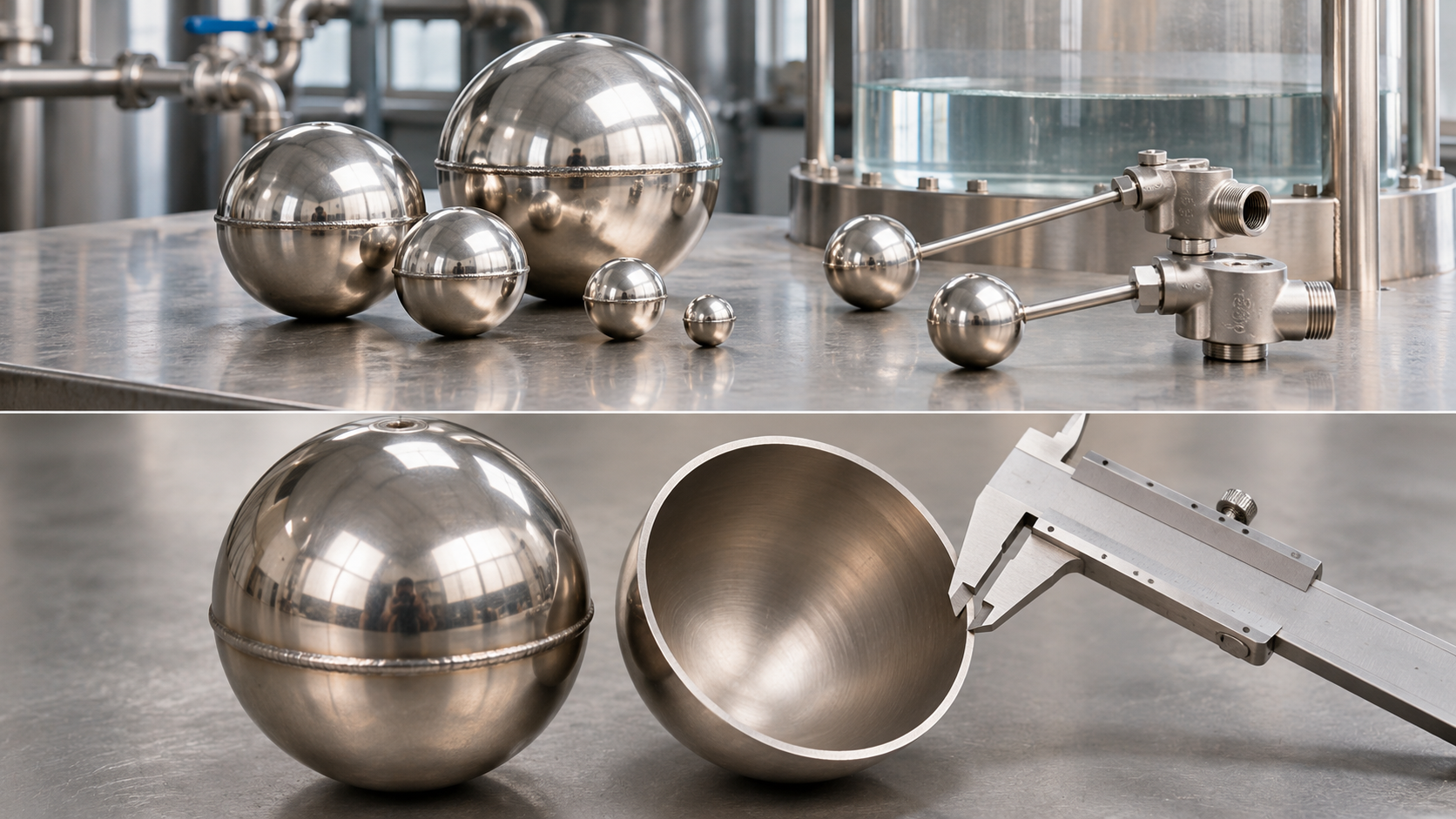
A hollow stainless steel ball may look like a simple component, but selecting one for a float valve or liquid-level control assembly requires more than choosing a diameter and material grade. The sphere must displace enough liquid to support its own weight and operate the mechanism. At the same time, its shell, welds and attachment points must withstand the intended operating conditions.
For OEM engineers and purchasing teams, the most reliable approach is to define the liquid, working temperature, buoyancy requirement, outer diameter, wall thickness and mounting design together. This guide explains how those decisions interact, what to test before production, and what information to include in an RFQ for custom hollow stainless steel balls.
1. Will a Hollow Stainless Steel Ball Actually Float?
Not every hollow metal sphere floats. A sealed sphere floats only when it can displace enough liquid to balance the total weight it carries. That weight includes the metal shell, welded seams, bosses, fittings and any load supported by the float.
The basic principle is Archimedes’ law: buoyant force equals the weight of displaced liquid. For a free-floating sealed sphere, the maximum available buoyancy depends on its outer volume and the liquid density. A float valve must also generate enough usable force at its operating immersion depth to move the arm or actuate the valve.
Consider two illustrative, idealized stainless steel shells of the same 0.5 mm wall thickness, using a nominal metal density of 8.0 g/cm³:
| Outer diameter | Ideal shell mass | Maximum water displaced | Preliminary result |
|---|---|---|---|
| 20 mm | Approximately 4.8 g | Approximately 4.2 g | The bare shell would not float in water |
| 80 mm | Approximately 79 g | Approximately 268 g | Buoyancy is possible, subject to design and testing |
These figures exclude welds and fittings. They are geometric estimates, not SDBALLS production specifications or verified performance ratings.
They demonstrate an important principle: at a fixed wall thickness, increasing sphere diameter can substantially improve the ratio of displaced volume to shell weight. Actual weld mass, shell thickness variation and mounting hardware change the result.
2. Start with the Liquid, Not the Ball Diameter
Float performance changes with the liquid. Water, oils, cleaning solutions and other process fluids have different densities; temperature can also change density.
A sphere that floats comfortably in water may sit deeper—or fail to operate a mechanism—in a lower-density liquid.
Before selecting a sphere, determine the following:
- Fluid and minimum expected density: Use the lowest operating density, not just a room-temperature reference.
- Temperature range: Include normal temperature, cleaning cycles and short-duration peaks if relevant.
- Chemical environment: Identify chlorides, detergents, acids or other substances that could affect the shell and welds.
- Operating pressure: An open tank, pressurized vessel and vacuum application present different mechanical demands.
- Available movement: Confirm the immersion depth, clearance and the force needed to move the valve arm.
For a lever-operated float valve, a ball that stays afloat is not necessarily strong enough to close the valve. The lever geometry, valve-seat force and required operating margin must also be evaluated at assembly level.
3. Match the Outer Diameter to the Required Buoyancy
Outer diameter controls displaced volume.
A larger sphere can displace more liquid, but may not fit inside the tank or may interfere with surrounding components. A smaller float saves space but offers less displacement at the same immersion depth.
When reviewing a drawing, check the minimum clearance to the tank wall, guide, inlet and moving parts.
Note the liquid level at which the valve must start closing or opening. For applications that need a particular switching point, calculate buoyancy at the actual submerged volume, not at full immersion.
If you are replacing an existing component, provide the old float’s diameter, mass and installation geometry along with the new performance requirement. These details are often more useful than a diameter alone.
4. Choose Wall Thickness for Both Weight and Mechanical Integrity
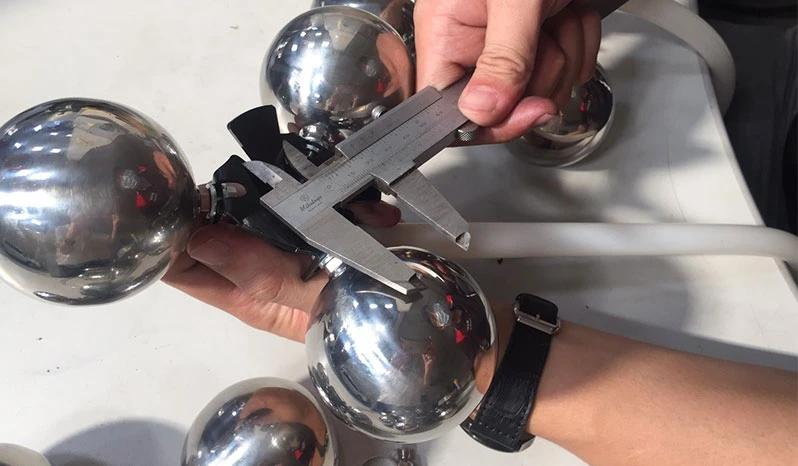
Wall thickness affects two competing requirements:
- Thinner walls reduce shell mass and can increase available buoyancy, but may be more vulnerable to denting, manufacturing variation or external pressure.
- Thicker walls can improve structural margin for some designs, but increase weight and reduce the space available for a hollow interior.
The correct choice depends on diameter, grade, forming and welding process, attachment design and pressure conditions.
Avoid specifying the thinnest possible wall before confirming how the float will be mounted and tested.
SDBALLS lists a broad range of hollow-sphere sizes and wall thickness options on its product page.
Specific diameter–wall combinations, tolerances and float performance require production confirmation. A catalog range does not mean every combination is suitable for liquid-level service.
5. Select Stainless Steel Grade by Fluid Compatibility
Material grade affects corrosion resistance and fabrication, but it does not determine buoyancy by itself.
| Stainless grade | Selection consideration | What must be confirmed |
|---|---|---|
| AISI 201 | Potential option for mild, cost-sensitive environments | Corrosion suitability and fabrication feasibility |
| AISI 304 / 304L | Common starting point for many freshwater and general industrial systems | Water chemistry, cleaning agents, temperature and weld design |
| AISI 316 / 316L | Often considered where chloride exposure or more demanding corrosion conditions justify it | Actual chemical compatibility, weld quality and required service life |
Neither 304 nor 316 makes a float universally resistant to every process liquid.
For aggressive fluids, request an application-specific materials review, especially around welded areas and mounting connections.
6. Treat Welded Seams, Holes and Mounting Points as Critical Details
Many hollow metal spheres are formed from shell sections and welded into a closed body.
If the sphere must float, the entire assembly must remain adequately sealed for its intended service life.
A polished seam alone does not demonstrate leak tightness.
Confirm whether the component is a fully sealed sphere, has a threaded boss, connects to a rod or contains another opening.
An open hole is not equivalent to a sealed float. If an attachment is welded to the shell, its design may affect local stresses, mass and sealing performance.
Useful acceptance checks may include dimensional inspection, mass measurement, visual seam inspection and a leak test appropriate to the application.
For pressure, hot-liquid or repeated-cycle service, agree on the specific test method, temperature, pressure differential, duration and pass/fail criteria before manufacturing.
No single generic test proves suitability for every valve system.
7. Specify the Component’s Role Correctly
An important distinction for purchasing teams is the difference between a buoyant float ball and a valve closure ball.
A buoyant float is intended to move with liquid level, often through a rod or lever.
A closure ball may contact a valve seat to regulate flow.
These functions impose different requirements for surface finish, roundness, deformation, sealing and loading.
Likewise, a fabricated hollow float should not be specified as a substitute for a high-grade solid bearing ball.
Tell the manufacturer which function your sphere performs. This avoids quotation based on appearance rather than actual duty.
8. What to Send with an OEM Quotation Request
A clear RFQ makes feasibility review and sample testing much faster:
| RFQ item | Information to provide |
|---|---|
| Aplikacja | Float valve, level switch, liquid-level indicator or other assembly |
| Liquid | Name, composition and minimum operating density |
| Operating conditions | Normal/peak temperature, pressure or vacuum, cleaning exposure |
| Sphere geometry | Outer diameter, target wall thickness, tolerance and target mass |
| Tworzywo | Preferred 201, 304/304L, 316/316L or request for recommendation |
| Connection | Fully sealed sphere, boss, threaded fitting, rod or custom interface |
| Wydajność | Required immersion depth, lift/actuation force or reference sample |
| Acceptance tests | Sealing test, dimensions, surface finish, inspection records |
| Commercial details | Quantity, drawing/sample, packing and delivery destination |
If a previous float is already working in your equipment, include the sample’s measured weight and a photo of the mounting point.
If the liquid is hot, pressurized or unusually low-density, highlight this at the beginning of the request.
Common Questions from Industrial Buyers
Can a hollow stainless steel ball float in hot water?
It may, but this must be established from the complete design. Water density, shell mass, seal integrity, pressure differential and the assembly’s required buoyant force all matter. Ask for an agreed sample test at representative conditions.
Is 316 stainless steel always better than 304 for float valves?
Not necessarily. 316 generally provides better resistance to certain chloride-related corrosion mechanisms, but grade choice should reflect the actual liquid, temperature, fabrication method and project budget. Neither grade guarantees performance in all chemicals.
Does a welded hollow sphere need a leak test?
For service where liquid ingress would change mass or buoyancy, a suitable sealing verification is important. Agree on test conditions and acceptance criteria before placing an order.
Can I order a custom size or wall thickness?
Custom configurations can be reviewed against forming, welding and inspection capabilities. Provide your drawing, required quantity and operating conditions so feasibility can be confirmed.
Request a Float-Ball Quotation from SDBALLS
SDBALLS supports custom hollow metal sphere projects for industrial applications.
For a float-valve inquiry, send us the outside diameter, wall thickness, material, liquid and temperature range, required buoyancy or sample weight, connection details, acceptance tests and quantity.
Start with the Stainless Steel Hollow Balls product page or contact SDBALLS with your drawing or reference sample.
Our team can review the requested geometry and discuss manufacturing feasibility and suitable sample validation before production.

O autorze
Jesteśmy firmą SD Ball, profesjonalnym producentem specjalizującym się w dostarczaniu precyzyjnych rozwiązań w zakresie kul stalowych na całym świecie. Dzięki wieloletniemu doświadczeniu specjalizujemy się w zaawansowanych procesach produkcyjnych, ścisłej kontroli jakości oraz dostosowanych rozwiązaniach, wspierających różnorodne zastosowania przemysłowe. Od doboru materiałów po kontrolę końcową, zapewniamy niezawodne produkty i stałą wydajność, pomagając naszym klientom osiągnąć wyższą wydajność, trwałość i jakość produktu.
Udział
Kategoria produktu
Powiązane artykuły
-
Precision Glass Balls: Materials, Grades and Industrial Applications
Precision glass balls are widely used in industrial components where non-magnetic properties, electrical insulation, chemical resistance and consistent spherical geometry are important. They can be found in check valves, metering pumps, flow meters, laboratory equipment and various fluid-control systems. However, not all glass balls are suitable for the same applications. Material composition, diameter, precision grade,… -
How to Choose Grinding and Polishing Media for Industrial Applications
Choosing the right grinding and polishing media is an important step in achieving consistent industrial processing results. Whether your application involves removing burrs from metal parts, improving surface smoothness, refining materials or polishing precision components, the type of media you select can influence processing efficiency, wear, surface quality and operating costs. However, not all grinding…