
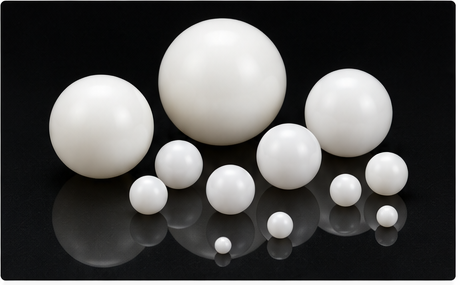


Bolas de Delrin POM – Bolas de Plástico Acetal para Válvulas de Baja Fricción, Rodamientos y Componentes Deslizantes
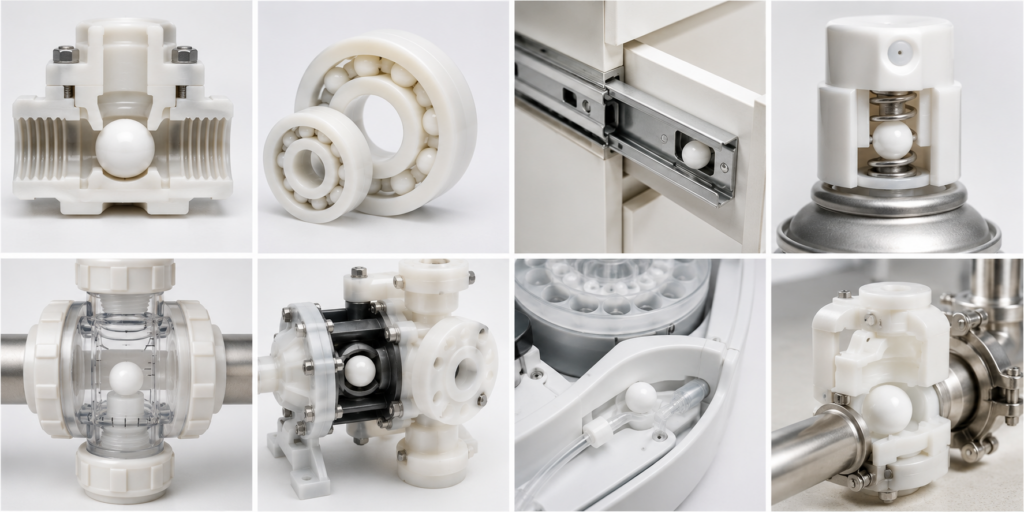
Las bolas de Delrin POM, también conocidas como bolas de plástico acetal o bolas de polioximetileno, son bolas de plástico de ingeniería ligeras diseñadas para baja fricción, buena resistencia al desgaste, estabilidad dimensional y aislamiento eléctrico. Se utilizan comúnmente como alternativas a las bolas metálicas en válvulas de seguridad ligeras, rodamientos de baja carga, agitadores de pulverización, rieles deslizantes de muebles, verificadores de flujo de fluidos, bombas y válvulas especializadas y conjuntos eléctricamente sensibles.
SDBALLS suministra bolas de POM en color blanco natural y colores personalizados, con diámetros comunes desde 1.5 mm hasta 160 mm y grados de precisión I, II y III. En comparación con las bolas de nylon, las bolas de POM generalmente ofrecen menor absorción de humedad y mejor estabilidad dimensional. En comparación con las bolas metálicas, son más ligeras, no magnéticas, resistentes a la corrosión en muchos medios compatibles y adecuadas para aplicaciones de baja carga con funcionamiento en seco o autolubricante.
| Artículo | Contenido recomendado de la página |
| Material | POM / Polioximetileno / Resina acetal;
Delrin es un nombre comercial ampliamente utilizado para el material de homopolímero de acetal. |
| Rango de diámetro | 1,5 mm – 160 mm; tamaños personalizados sujetos a confirmación de producción |
| Grados de precisión | Grado I, II, III; seleccionado según tolerancia, aplicación y objetivo de costo |
| Dureza | Típico Shore D 80-90 |
| Aplicaciones típicas | Válvulas de seguridad ligeras, válvulas de retención, cojinetes de baja carga, agitadores de pulverización, rieles deslizantes para muebles, caudalímetros, verificadores de flujo de fluidos, bombas, componentes de válvulas, equipos médicos, partes electrónicas y equipos relacionados con alimentos cuando el grado de resina es adecuado |
Comparte este producto
Descripción general del producto
Las bolas de POM Delrin son bolas de plástico de precisión fabricadas con polioximetileno (POM), un termoplástico de ingeniería semicristalino conocido por su equilibrio entre resistencia mecánica, baja fricción, resistencia al desgaste y estabilidad dimensional. En aplicaciones industriales con bolas, el POM suele elegirse cuando los diseñadores necesitan una bola ligera, no magnética y aislante eléctricamente que pueda funcionar suavemente en sistemas mecánicos o de control de fluidos de baja carga.
A diferencia de las bolas de acero, las bolas de POM no ofrecen alta resistencia a la fatiga en rodamientos ni el rendimiento metálico a altas temperaturas. Su valor es diferente: reducen el peso, evitan el ruido de metal contra metal, resisten muchos aceites y combustibles, y pueden operar con baja fricción en conjuntos secos o ligeramente lubricados. Esto las hace prácticas para válvulas, dispositivos de control de flujo, rieles deslizantes, cojinetes de baja carga, bombas, sistemas de pulverización e instrumentos donde la corrosión, el aislamiento eléctrico o la reducción de peso son importantes.
Selección de Materiales y Posicionamiento Técnico
El POM se compara frecuentemente con bolas de nailon, polietileno, acrílico, PTFE y metal. La selección correcta depende de la temperatura de trabajo, la carga, la exposición química, la tolerancia dimensional y si se requiere aislamiento eléctrico.
- Elija bolas de POM cuando se requiera baja fricción, baja absorción de humedad, estabilidad dimensional y resistencia al desgaste.
- Elija bolas de nailon cuando la tenacidad y la resistencia al impacto sean más importantes y se pueda aceptar cierta absorción de humedad.
- Elija bolas de HDPE o PP cuando el requisito principal sea una densidad muy baja o una amplia resistencia química en usos más ligeros.
- Elija bolas de PTFE cuando se requiera muy baja fricción y mayor resistencia química, pero la rigidez mecánica sea menor.
- Elija bolas de acero inoxidable, acero al cromo o cerámica cuando se requiera mayor carga, mayor temperatura, rendimiento de precisión en rodamientos o una dureza muy alta.
Propiedades Técnicas y Rendimiento
| Propiedad | Valor de Referencia Típico |
| Tipo de producto | Bolas de plástico de ingeniería macizas para aplicaciones de baja fricción, aislantes y resistentes a la corrosión |
| Familia de materiales | Plástico de ingeniería POM / acetal |
| Color | Blanco natural; disponible en negro o colores personalizados |
| Dureza | Shore D 80-90 |
| Densidad | Aprox. 1.37-1.42 g/cm3 |
| Módulo de elasticidad | Aprox. 2.5-4.0 GPa dependiendo del grado de resina |
| Magnetismo | No magnético |
| Resistencia de referencia a tracción / compresión | Rango de ingeniería común alrededor de 30-120 MPa dependiendo del método de prueba y del grado de resina |
| Temperatura de servicio | Normalmente de -40 C a +85 C para aplicaciones con bolas |
| Comportamiento de fricción | Baja fricción y comportamiento autolubricante |
| Absorción de agua | Baja en comparación con el nailon |
| Propiedades eléctricas | Buen aislamiento eléctrico |
| Absorción de humedad | Baja absorción de humedad en comparación con el nailon; favorece una mejor estabilidad dimensional en muchas aplicaciones |
| Resistencia química | Buena resistencia a aceites, grasas, combustibles, muchos hidrocarburos y medios químicos débiles; no apto para ácidos fuertes, álcalis fuertes, agentes oxidantes o exposición química agresiva prolongada sin confirmación |
Resistencia química y límites de aplicación
Las bolas de POM ofrecen una resistencia útil a muchos aceites, grasas, productos derivados del petróleo, combustibles, hidrocarburos alifáticos, alcoholes débiles y muchas soluciones acuosas neutras. Esto las hace adecuadas para muchas aplicaciones de válvulas, bombas, control de flujo y mecánicas donde la corrosión del metal o la conductividad eléctrica no son deseables.
El POM no es un plástico universal resistente a productos químicos. Generalmente no se recomienda para ácidos fuertes, álcalis fuertes, agentes oxidantes, medios clorantes fuertes, exposición a agua caliente/vapor o exposición prolongada a rayos UV en exteriores sin confirmación técnica. Para entornos químicos agresivos, el PTFE, ciertas cerámicas, el acero inoxidable, el vidrio u otros materiales plásticos pueden ser más apropiados.
Aplicaciones y Adecuación
| Solicitud | Nivel de ajuste | Por qué encaja | Nota para el comprador |
| Válvulas de seguridad ligeras / Válvulas de retención | Muy bueno | Bajo peso, resistencia a la corrosión en medios compatibles y comportamiento de asentamiento suave | Confirmar el medio, la temperatura, la presión y el diseño del asiento. |
| Rodamientos de baja carga | Bien | Baja fricción, bajo ruido y comportamiento autolubricante | No apto para aplicaciones de fatiga de rodamientos de precisión a alta velocidad o alta carga. |
| Rieles deslizantes para muebles | Bien | Reduce la fricción y el ruido en comparación con el contacto metálico | Confirme la carga del riel, el ciclo de desgaste y la tolerancia dimensional. |
| Agitadores de pulverización / sistemas de aerosol | Bien | Ligero y químicamente compatible con muchos fluidos | Confirme el propelente, el solvente y la exposición a productos químicos. |
| Verificadores de flujo de fluidos / caudalímetros | Bien | No magnético, ligero y aislante eléctricamente | Confirme el requisito de densidad y la compatibilidad con el fluido. |
| Bombas y válvulas especializadas | Bien | Útil donde se requiera resistencia a la corrosión y contacto no metálico | Confirme la resistencia química y la temperatura de funcionamiento. |
| Equipo médico / farmacéutico | Depende de la aplicación | Una bola no metálica lisa puede ser adecuada para equipos seleccionados | Confirme el grado de resina, la limpieza y los requisitos normativos. |
| Equipos relacionados con alimentos | Depende de la aplicación | Se puede usar POM cuando se confirman el grado adecuado y el cumplimiento | Confirme el grado de contacto con alimentos y las condiciones de limpieza antes de cotizar. |
| Rodamientos de alta carga / sistemas de alta temperatura | Limitado | Las bolas de plástico no pueden sustituir al acero templado o a la cerámica en condiciones severas | Considere bolas de acero inoxidable, acero al cromo o cerámica. |
Guía de Selección de Materiales
| Opción de material | Resistencia típica | Limitación | Cuándo recomendar |
| Bolas de POM / Delrin / Acetal | Baja fricción, buena rigidez, baja absorción de humedad, estabilidad dimensional | Limitado en ácidos fuertes, álcalis fuertes, alta temperatura y cargas pesadas | Válvulas, rodamientos de baja carga, rieles deslizantes, dispositivos de flujo y componentes aislantes |
| Bolas de nailon / PA | Buena tenacidad y resistencia al impacto | Mayor absorción de humedad que el POM; el cambio dimensional puede ser mayor | Piezas propensas a impactos y uso general de bolas de plástico de ingeniería |
| Bolas de HDPE | Muy ligeras, buena resistencia química, bajo costo | Menor rigidez y dureza que el POM | Bolas flotantes, control de evaporación y aplicaciones químicas ligeras |
| Bolas de PTFE | Excelente resistencia química y fricción muy baja | Menor rigidez y mayor coste | Válvulas para químicos agresivos y aplicaciones de muy baja fricción |
| Bolas de acero inoxidable | Mayor resistencia, capacidad térmica y resistencia a la corrosión según el grado | Más pesado, conductor y de mayor coste | Bombas, válvulas, rodamientos y aplicaciones que requieren resistencia metálica |
| Bolas cerámicas | Alta dureza, resistencia a la corrosión y potencial para altas temperaturas | Consideración de mayor coste y fragilidad | Aplicaciones de alto desgaste, químicos agresivos o precisión especial |
Fabricación y Control de Procesos
SDBALLS controla el suministro de bolas de POM mediante la selección de resina, confirmación del proceso de formado o mecanizado, dimensionamiento, acabado, limpieza, inspección y embalaje. Para bolas de plástico, el control del proceso se centra en la consistencia dimensional, redondez, superficie lisa, consistencia del color, control de rebabas y trazabilidad del material cuando se requiera.
Para proyectos OEM, el método de producción y el nivel de tolerancia deben adecuarse a la aplicación. Los componentes pequeños de precisión, bolas de válvula y bolas de control de flujo pueden requerir un control más estricto del diámetro y la superficie, mientras que las bolas de plástico grandes de uso general pueden utilizar una clase de tolerancia más económica.
Control de Calidad e Inspección
- Inspección de diámetro y tolerancia según el grado acordado.
- Inspección de redondez y apariencia superficial en busca de rebabas, arañazos, marcas de rebaba y contaminación.
- Confirmación del material según grado de resina, color y requisitos de la orden de compra.
- Confirmación de dureza o propiedad del material cuando lo especifique el comprador.
- Verificaciones basadas en la aplicación para asiento de válvula, comportamiento de flujo, movimiento de baja fricción o ajuste de ensamblaje cuando se proporcionan muestras.
- Soporte para informes de inspección, solicitudes RoHS / REACH, pruebas de terceros y etiquetado personalizado cuando se requiera para proyectos OEM.
Opciones de Embalaje
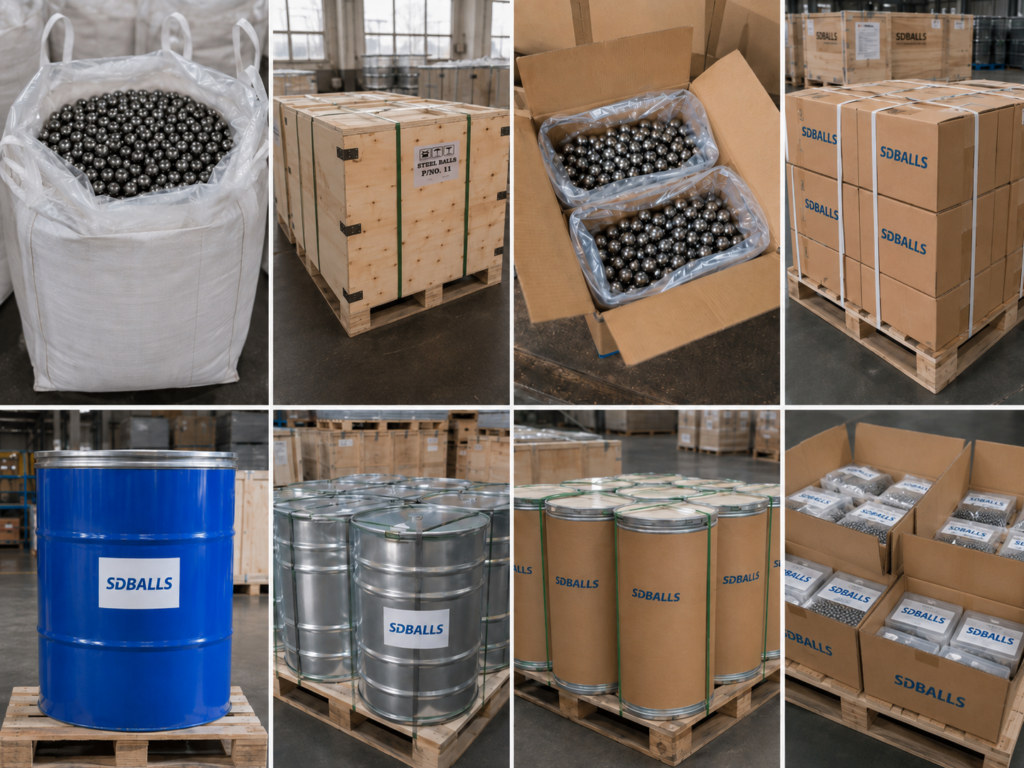
Las bolas de POM se pueden empaquetar en bolsas de plástico, cajas de cartón, cubos, tambores o cajas de exportación paletizadas según el diámetro, la cantidad y los requisitos de manipulación del cliente. Para aplicaciones limpias, SDBALLS puede ofrecer limpieza mejorada, bolsas internas selladas, etiquetas de lote y empaque OEM personalizado.
- Empaque en bolsa a granel o caja de cartón para uso industrial general.
- Empaque en bolsa pequeña o cubo para inventario de distribuidores y uso de mantenimiento.
- Empaque de exportación paletizado para pedidos a granel.
- Etiqueta personalizada con nombre del producto, material, diámetro, cantidad, número de lote y código del cliente cuando se requiera.
Cómo Especificar para una Cotización
Para cotizar bolas de Delrin POM con precisión, confirme la siguiente información:
- Requisito del material: POM, acetal, Delrin, homopolímero/copolímero si se especifica en el dibujo.
- Diámetro en mm o pulgadas y tolerancia o grado de precisión requerido.
- Requisito de color: blanco natural, negro o color personalizado.
- Aplicación: válvula, cojinete, medidor de flujo, riel deslizante, bomba, agitador de pulverización u otro uso.
- Entorno de trabajo: temperatura, contacto con fluidos/productos químicos, presión, carga y velocidad de funcionamiento.
- Documentos requeridos: informe de inspección, RoHS/REACH, confirmación de material apto para contacto con alimentos o pruebas de terceros si es necesario.
- Cantidad, método de embalaje, puerto de destino y término comercial.
Preguntas frecuentes técnicas
P: ¿De qué material están hechas las bolas de pompones de Delrin?
R: Están fabricados en POM, también llamado polióxido de metileno o acetal. Delrin es un nombre comercial común para el material homopolímero de acetal. Si un plano exige un grado de resina específico, debe confirmarse el grado antes de cotizar.
P: ¿Son las bolas de POM iguales a las bolas de nylon?
R: No. Ambas son bolas de plástico técnico, pero el POM generalmente tiene menor absorción de humedad, mejor estabilidad dimensional y rendimiento de baja fricción. El nylon suele ofrecer buena tenacidad y resistencia al impacto, pero puede absorber más humedad.
P: ¿Qué tamaños y grados puede suministrar SDBALLS?
R: Los diámetros comunes van de 1,5 mm a 160 mm, con grados de precisión I, II y III. Los tamaños, colores y niveles de tolerancia especiales pueden consultarse según la cantidad y la aplicación.
P: ¿Cuál es el rango de temperatura de servicio para las bolas de POM?
R: Un rango de referencia práctico para aplicaciones con bolas de POM es aproximadamente de -40 °C a +85 °C. Es posible una exposición breve a temperaturas más altas para grados seleccionados, pero debe verificarse junto con la carga, el contacto químico y la duración.
P: ¿Son las bolas de Delrin POM resistentes a la corrosión?
R: Resisten muchos aceites, grasas, productos petrolíferos, combustibles y medios químicos neutros o débiles. No se recomiendan para ácidos fuertes, álcalis fuertes, agentes oxidantes o exposición química agresiva sin confirmación del material.
P: ¿Se pueden usar las bolas de POM en equipos alimentarios o médicos?
R: Pueden ser adecuadas para algunos equipos relacionados con alimentos o de uso médico solo cuando se confirman el grado de resina, la limpieza, los documentos de conformidad y las condiciones de aplicación. No se debe asumir que todas las bolas de POM son de grado alimentario o médico.
P: ¿Pueden las bolas de POM sustituir a las bolas de acero?
R: Pueden reemplazar bolas de acero en aplicaciones adecuadas de baja carga, baja fricción, aislamiento o sensibles a la corrosión. No deben usarse como sustituto directo de bolas de acero en aplicaciones de rodamientos de alta carga, alta velocidad, alta temperatura o críticas por fatiga.
P: ¿Qué información se necesita antes de realizar un pedido?
R: Por favor, proporcione el grado del material, diámetro, tolerancia o grado, color, aplicación, temperatura de trabajo, exposición química, cantidad, embalaje, documentos de inspección y destino.
Productos relacionados
Solicitud de programación
Contáctanos hoy para cualquier servicio. (*) Indica campos obligatorios.