
-6.png)
-5.png)
-5.png)
-5.png)
-5.png)
Bolas de Vidrio de Borosilicato – Bolas de Vidrio de Precisión con Alta Resistencia Química y Térmica
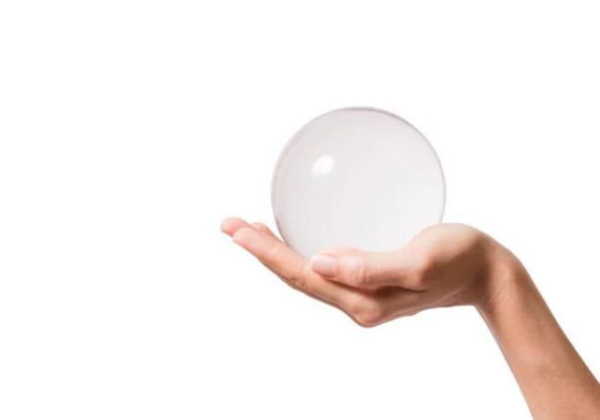
Las bolas de vidrio de borosilicato son esferas de vidrio de precisión diseñadas para aplicaciones químicamente agresivas, térmicamente exigentes, no magnéticas y con aislamiento eléctrico. En comparación con las bolas de vidrio de cal sodada estándar, las bolas de vidrio de borosilicato ofrecen una mayor resistencia al choque térmico y una estabilidad química mejorada, lo que las hace adecuadas para bombas dosificadoras, válvulas de retención, válvulas de bola, sistemas de dosificación, equipos de laboratorio, componentes de dispensación farmacéutica y cosmética, y aplicaciones seleccionadas de molienda o relleno.
SDBALLS suministra bolas de vidrio de borosilicato transparente en tamaños de 2,0 mm a 100,00 mm, con grados de precisión comunes como G20, G40, G100, G200, G500 y G1000. El material es no magnético, resistente a la corrosión, aislante eléctricamente y adecuado para aplicaciones donde la inspección visual, la resistencia química y el rendimiento estable bajo variaciones de temperatura son importantes.
| Artículo | Contenido recomendado de la página |
| Nombre del producto | Bolas de vidrio de precisión / esferas de vidrio de borosilicato |
| Material | Vidrio de borosilicato / vidrio técnico |
| Rango de diámetro | 2,0 mm – 100,00 mm |
| Grados de precisión | G20, G40, G100, G200, G500, G1000 |
| Dureza | Mohs 6 valor de referencia |
| Aplicaciones típicas | Bombas dosificadoras, válvulas de retención, válvulas de bola, perlas dosificadoras, sistemas de dosificación, equipos de laboratorio, componentes de dispensación farmacéutica y cosmética, material de relleno, medios de molienda seleccionados |
Comparte este producto
Descripción general del producto
Las Bolas de Vidrio de Borosilicato son esferas de vidrio de precisión fabricadas para aplicaciones donde la resistencia química, la estabilidad térmica, el rendimiento no magnético y la claridad visual son más importantes que la resistencia al impacto similar al metal o la alta capacidad de carga de rodamientos. Se utilizan ampliamente en equipos de control de flujo, medición, dosificación, laboratorio, farmacéuticos, cosméticos y de procesos industriales.
En comparación con las bolas de vidrio de cal sodada, las bolas de vidrio de borosilicato ofrecen una mejor resistencia al choque térmico y una durabilidad química mejorada. En comparación con las bolas de metal, son no magnéticas, aislantes eléctricas, resistentes a la corrosión y visualmente transparentes. En comparación con las bolas de plástico, proporcionan mayor dureza, mejor estabilidad dimensional a temperaturas elevadas y mejor resistencia a muchos medios agresivos.
Selección de Materiales y Posicionamiento Técnico
El vidrio de borosilicato es un vidrio técnico basado principalmente en sílice y óxido de boro. La baja expansión térmica y la alta durabilidad química del vidrio de borosilicato lo convierten en la opción preferida para entornos exigentes de control de fluidos y laboratorio donde el vidrio ordinario o los plásticos pueden deformarse, agrietarse, hincharse o perder estabilidad.
Este producto no debe posicionarse como una bola de soporte de alta carga o un reemplazo metálico resistente al impacto. Se especifica mejor cuando el comprador necesita resistencia a la corrosión, resistencia al choque térmico, aislamiento eléctrico, comportamiento no magnético, apariencia clara y rendimiento predecible en válvulas, bombas, sistemas de medición y conjuntos de proceso.
Especificaciones técnicas
| Propiedad | Contenido Típico / Recomendado |
| Rango de diámetro | 2.0 mm – 100.00 mm; otros tamaños sujetos a confirmación de producción |
| Grado de precisión | G20, G40, G100, G200, G500, G1000; seleccionado según la aplicación y el objetivo de coste |
| Dureza | Escala de Mohs 6 |
| Densidad | Aprox. 2.2-2.3 g/cm3 |
| Módulo de Young | Rango de referencia aproximado de 60-65 GPa |
| Magnetismo | No magnético |
| Color | Claro / transparente |
| Resistencia al desgaste | Regular a bueno, dependiendo del medio y la carga |
| Comportamiento eléctrico | Excelente aislante eléctrico |
| Resistencia química | Excelente resistencia a la corrosión y a la mayoría de los ácidos; la compatibilidad química debe confirmarse para el medio real |
| Rendimiento Térmico | Alta resistencia al choque térmico; apto para aplicaciones a temperatura elevada dentro de los límites de trabajo confirmados. |
| Acabado superficial | Pulido o acabado de precisión según el grado y la aplicación. |
Referencia de Composición Química
La composición química del vidrio de borosilicato puede variar según la formulación y la norma del proveedor. La siguiente tabla es un rango de referencia para la comunicación en ingeniería y compras. La especificación final del material debe seguir la orden de compra, el plano, la muestra aprobada o el informe de ensayo acordados.
| Componente | Rango de referencia |
| SiO2 | 65.00-85.00 % |
| B2O3 | 8.00-15.00 % |
| Na2O | 3.00-9.00 % |
| Al2O3 | 1.00-5.00 % |
| CaO | Máx. 2.50 % |
| K2O | Máx. 2.00 % |
| BaO | Máx. 1.00 % |
Resistencia al Calor, Resistencia Química y Rendimiento
Las bolas de vidrio de borosilicato se seleccionan para medios agresivos y variaciones de temperatura porque el material tiene un coeficiente de expansión térmica más bajo que el vidrio de cal sodada y una mejor resistencia al choque térmico. Son adecuadas para muchos entornos donde el vidrio estándar o los plásticos pueden ser menos estables.
Para servicio químico, el vidrio de borosilicato proporciona una excelente resistencia a la corrosión y a la mayoría de los ácidos. Sin embargo, los compradores no deben tratar ningún vidrio como universalmente resistente a todos los químicos. El ácido fluorhídrico, los álcalis fuertes calientes, el alto impacto mecánico, las suspensiones abrasivas y los choques rápidos de presión requieren una evaluación especial antes de la selección del material.
Aplicaciones y Adecuación
| Solicitud | Nivel de ajuste | Por qué encaja | Nota para el comprador |
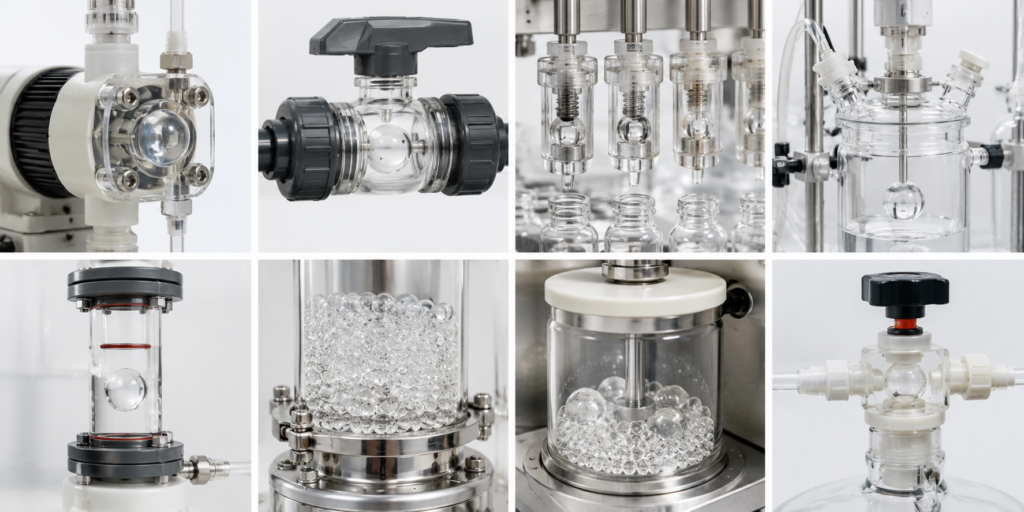
| Bombas dosificadoras y sistemas de dosificación | Muy bueno | La estabilidad química, la apariencia transparente y la geometría esférica estable favorecen la consistencia en la dosificación | Confirmar el medio químico, la temperatura y los requisitos de sellado |
| Válvulas de retención y válvulas de bola | Muy bueno | Las bolas de vidrio no corrosivas y no magnéticas proporcionan un sellado fiable en fluidos compatibles | Confirmar el material del asiento y las condiciones de presión |
| Componentes de dosificación farmacéutica y cosmética | Muy bueno | La apariencia clara, la resistencia a la corrosión y la superficie limpia facilitan la inspección visual | Confirmar los requisitos de limpieza, embalaje y normativa |
| Aparatos e instrumentos de laboratorio | Muy bueno | Buena resistencia química y térmica con aislamiento eléctrico | Confirmar la compatibilidad química real |
| Contadores de flujo e indicadores visuales | Bien | La bola transparente y no magnética permite el movimiento visible y la medición | Confirmar los requisitos de densidad y flotabilidad |
| Material de relleno / medio de proceso | Bien | Esfera de vidrio químicamente estable para ensamblajes de proceso compatibles | Confirmar el tamaño de partícula, limpieza y compatibilidad con los medios |
| Medio de molienda ligero | Depende de la aplicación | La superficie de vidrio duro puede ser útil donde debe evitarse la contaminación metálica | Evitar la molienda de alto impacto o altamente abrasiva |
| Rodamientos o mecanismos de impacto de alta carga | Limitado | El vidrio es duro pero frágil en comparación con el acero o la cerámica | Considere bolas de acero inoxidable, cerámica o metal en su lugar |
Guía de Selección de Materiales
| Opción de material | Resistencia típica | Limitación | Cuándo recomendar |
| Bolas de vidrio de borosilicato | Alta resistencia a choques térmicos, excelente resistencia química, transparente y no magnético | Frágil bajo impacto; no apto para cargas pesadas en rodamientos | Bombas dosificadoras, válvulas de retención, control de flujo en laboratorio, farmacéutica, cosmética y medios agresivos |
| Bolas de vidrio sódico-cálcico | Económico, duro, resistente a la corrosión en entornos estables | Menor resistencia al choque térmico que el borosilicato | Válvulas, instrumentos, tapas de botella, usos decorativos e industriales ligeros sensibles al costo |
| Bolas de vidrio negro | Opción de vidrio opaco, de bajo brillo y visualmente distintivo | Se debe confirmar la formulación del material y la resistencia a la corrosión | Aplicaciones ópticas, decorativas, de bajo brillo e instrumentos seleccionados |
| Bolas cerámicas | Dureza muy alta, resistencia al desgaste y a la corrosión | Mayor costo; la selección del material es más especializada | Aplicaciones de alto desgaste, químicas, de alta temperatura o precisión |
| Bolas de acero inoxidable | Más resistente que el vidrio y disponible en diferentes grados de resistencia a la corrosión | El rendimiento magnético/no magnético y la corrosión varían según el grado | Aplicaciones de mayor carga, conjuntos mecánicos, válvulas y metales sensibles a la corrosión |
| pelotas de plástico | Ligero y de bajo costo con amplias opciones químicas | Menor dureza y capacidad de temperatura que el vidrio | Válvulas de flotador, válvulas de baja carga, conjuntos ligeros y aplicaciones de plástico compatible químicamente |
Fabricación y Control de Procesos
Las bolas de vidrio de borosilicato requieren formación estable, dimensionamiento controlado, acabado de precisión, pulido, limpieza y clasificación para garantizar un rendimiento repetible en válvulas, sistemas de medición y conjuntos industriales. Para aplicaciones de precisión, el diámetro de la bola, la redondez, la apariencia superficial y la limpieza deben controlarse según el grado requerido y el uso final.
SDBALLS puede admitir pedidos estándar y personalizados según los requisitos de material, diámetro, grado, acabado, embalaje y aplicación. Para proyectos OEM, se recomienda la aprobación de muestras y la confirmación de la aplicación antes de la producción en masa.
Control de Calidad e Inspección
El control de calidad de las bolas de vidrio de borosilicato debe centrarse en la precisión dimensional, la consistencia del grado, la redondez, la apariencia de la superficie, la claridad, el control de la contaminación, el estado del embalaje y la compatibilidad con la aplicación. Para uso en sellado o dosificación, los compradores deben confirmar el grado y la tolerancia necesarios para un asiento y rendimiento de dosificación fiables.
- Inspección de diámetro y grado
- Comprobación de redondez y apariencia de la superficie
- Inspección visual de grietas, astillas e inclusiones evidentes
- Confirmación de material y color cuando sea necesario
- Inspección de limpieza y embalaje para aplicaciones farmacéuticas, cosméticas o de laboratorio
- Pruebas de terceros o documentos de inspección a solicitud del proyecto
Opciones de Embalaje
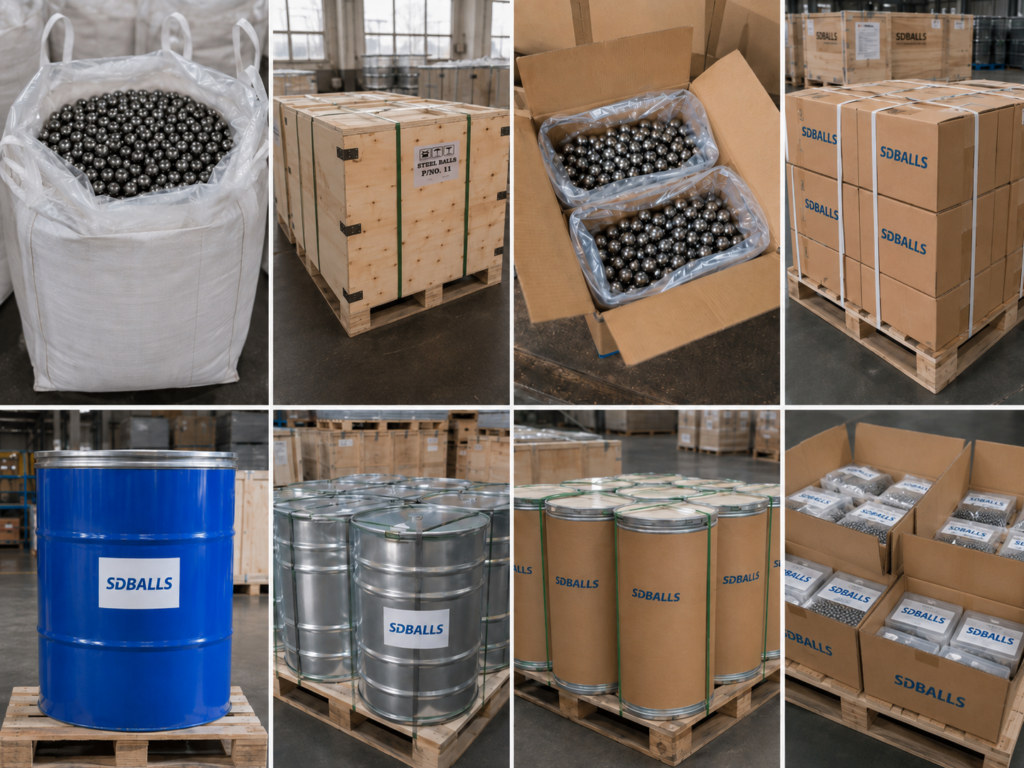
SDBALLS puede suministrar bolas de vidrio de borosilicato en embalaje industrial a granel o embalaje OEM personalizado según el tamaño, la cantidad, el requisito de limpieza y el método de envío. El embalaje protector es importante porque las bolas de vidrio deben protegerse de impactos, astillamientos y contaminación durante el transporte.
- Embalaje en bolsa de plástico + caja de cartón para cantidades pequeñas y medianas
- Embalaje en botella, cubo, bidón o caja de cartón según el diámetro y el peso
- Embalaje de exportación paletizado para pedidos a granel
- Etiquetas personalizadas con material, tamaño, grado, número de lote y cantidad
- Opciones de embalaje más limpias para programas de suministro de laboratorio, farmacéuticos o cosméticos
Cómo Especificar para una Cotización
Para cotizar bolas de vidrio borosilicato con precisión, por favor confirme la siguiente información:
- Material: vidrio borosilicato / estándar de vidrio requerido si se especifica
- Diámetro en mm o pulgadas
- Grado de precisión o tolerancia requerida
- Cantidad y estimación de demanda anual
- Aplicación: válvula, bomba dosificadora, sistema de dosificación, molienda, llenado, laboratorio, uso cosmético o farmacéutico
- Medio de trabajo, temperatura, presión y exposición química
- Requisitos de acabado superficial, limpieza y apariencia visual
- Método de embalaje y requisitos de etiquetado
- Requisitos de informe de inspección, prueba de terceros o aprobación de muestras
- Puerto de destino, término comercial y cronograma de entrega objetivo
Preguntas frecuentes técnicas
P: ¿Cuál es la diferencia entre las bolas de vidrio borosilicato y las bolas de vidrio sódico-cálcico?
R: Las bolas de vidrio borosilicato ofrecen una mejor resistencia al choque térmico y una estabilidad química más fuerte que las bolas de vidrio sódico-cálcico estándar. El vidrio sódico-cálcico se usa a menudo en aplicaciones sensibles al costo en entornos de temperatura estable, mientras que el vidrio borosilicato se prefiere para condiciones más severas, ya sean químicas o de temperatura.
P: ¿Son magnéticas las bolas de vidrio borosilicato?
R: No. Las bolas de vidrio borosilicato no son magnéticas, lo que las hace adecuadas para su uso cerca de instrumentos, sensores, sistemas de control de flujo y aplicaciones donde la interferencia magnética no es aceptable.
P: ¿Se pueden usar las bolas de vidrio borosilicato en válvulas de retención y bombas dosificadoras?
R: Sí. Se utilizan comúnmente en válvulas de retención, bombas dosificadoras, sistemas de dosificación y válvulas de bola donde se requiere resistencia química, geometría esférica estable y rendimiento no magnético. Se debe confirmar el material del asiento, la presión, la temperatura y el medio de trabajo.
Q: ¿Son resistentes a la corrosión las bolas de vidrio de borosilicato?
A: Sí, ofrecen una excelente resistencia a la corrosión y son resistentes a muchos ácidos y productos químicos. Sin embargo, siempre debe confirmarse la compatibilidad química, especialmente con ácido fluorhídrico, álcalis fuertes calientes o medios agresivos especiales.
Q: ¿Pueden las bolas de vidrio de borosilicato sustituir a las bolas de acero inoxidable?
A: Solo en aplicaciones adecuadas. El vidrio de borosilicato es resistente a la corrosión, no magnético y aislante eléctrico, pero es más frágil que el acero inoxidable. Para aplicaciones con impacto mecánico de alta carga o rodamientos, las bolas de acero inoxidable o cerámicas pueden ser más adecuadas.
P: ¿Qué grados de precisión están disponibles?
A: Los grados comunes incluyen G20, G40, G100, G200, G500 y G1000. El grado correcto depende de la precisión del sellado, el rendimiento de la dosificación, los requisitos superficiales y el objetivo de coste.
Q: ¿Pueden utilizarse estas bolas como medios de molienda?
A: Pueden usarse en aplicaciones seleccionadas de molienda ligera donde deba evitarse la contaminación metálica y la carga del proceso sea adecuada para medios de vidrio. No se recomiendan para molienda de alto impacto o pulpas altamente abrasivas sin pruebas previas.
P: ¿Qué información se necesita para una cotización?
A: Proporcione el material, diámetro, grado o tolerancia, cantidad, aplicación, medio químico de trabajo, temperatura, presión, acabado superficial, requisito de limpieza, método de embalaje, documentos de inspección y destino.
Productos relacionados
Solicitud de programación
Contáctanos hoy para cualquier servicio. (*) Indica campos obligatorios.