
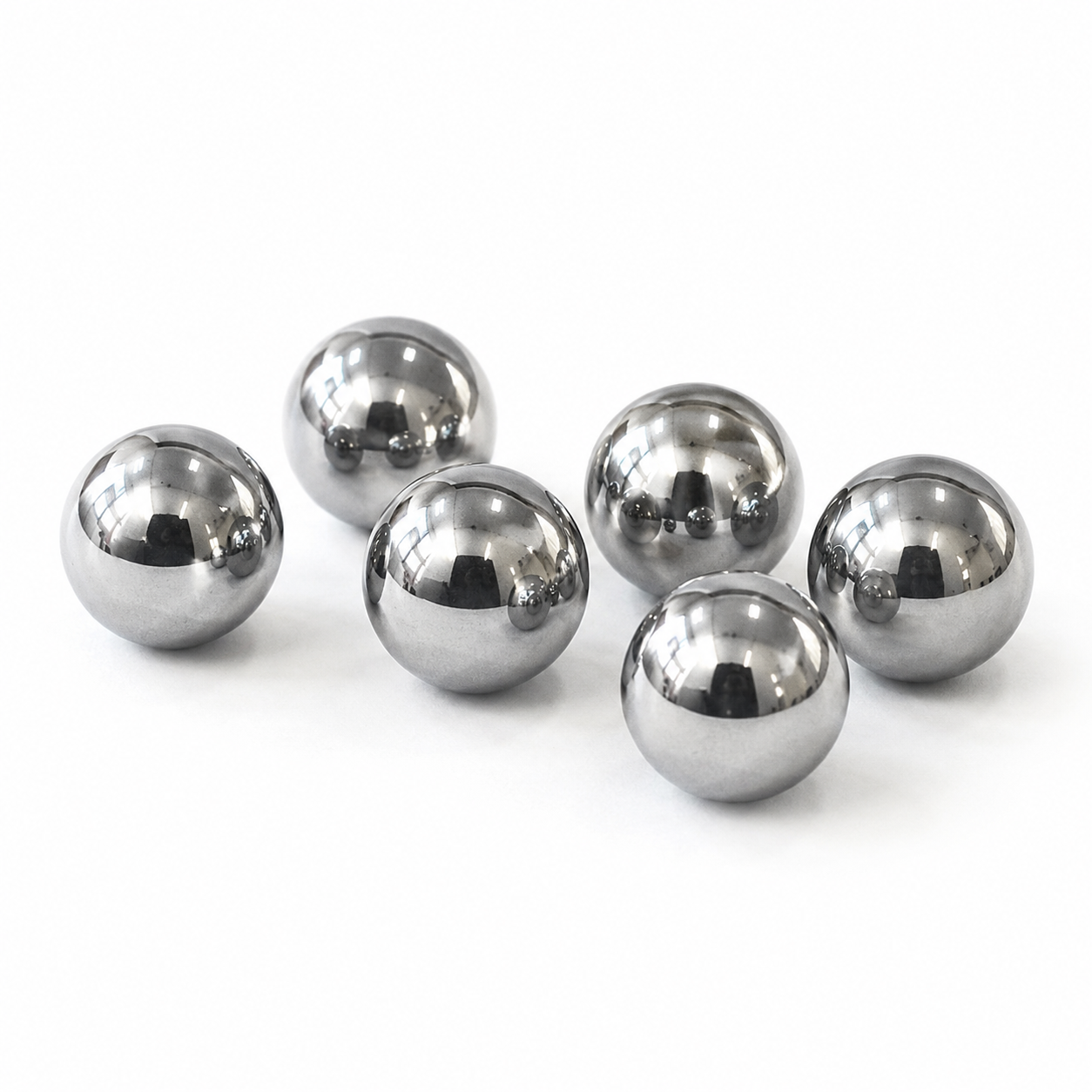
-3.png)
-4.png)
-4.png)
-4.png)
-4.png)
Bolas de acero inoxidable AISI 302/304/304L – Bolas de acero inoxidable austenítico para aplicaciones resistentes a la corrosión
Las Bolas de Acero Inoxidable AISI 302/304/304L son bolas de acero inoxidable austenítico no endurecido, diseñadas para aplicaciones donde la resistencia a la corrosión, la condición de superficie limpia, la tenacidad y el rendimiento mecánico estable son más importantes que la dureza máxima. Se utilizan ampliamente en bombas, pulverizadores, válvulas dosificadoras, válvulas para aplicaciones médicas, rodamientos especiales, equipos relacionados con alimentos, envases cosméticos y ensamblajes industriales generales resistentes a la corrosión.
SDBALLS suministra bolas de acero inoxidable AISI 302, AISI 304 y AISI 304L desde 0,5 mm hasta 150,00 mm, con grados de precisión comunes que incluyen G100, G200, G500 y G1000. Estas bolas se suministran típicamente en estado pasivado y pueden seleccionarse según el entorno corrosivo, el requisito de dureza, el comportamiento magnético, el acabado superficial y los requisitos de la aplicación.
| Artículo | Contenido recomendado de la página |
| Material | Acero inoxidable austenítico AISI 302 / AISI 304 / AISI 304L |
| Tipo de producto | Bolas de acero inoxidable austenítico no endurecidas / no templables en profundidad |
| Rango de diámetro | 0,5 mm – 150,00 mm |
| Grados de precisión | G100, G200, G500, G1000; |
| Dureza | HRC 20-39 según la condición del material y el trabajo en frío; |
| Aplicaciones típicas | Bombas, pulverizadores, válvulas para aerosoles, válvulas dispensadoras, envases cosméticos, válvulas para aplicaciones médicas, equipos relacionados con alimentos, rodamientos especiales, acoplamientos y mecanismos generales resistentes a la corrosión |
Comparte este producto
Descripción general del producto
Las bolas de acero inoxidable AISI 302/304/304L son bolas de acero inoxidable austenítico resistentes a la corrosión, producidas para aplicaciones mecánicas industriales, higiénicas, de manejo de fluidos y de semiprecisión. A diferencia de las bolas de acero inoxidable martensítico AISI 420C o 440C, estos grados no se seleccionan principalmente por su alta dureza. Sus principales ventajas son la resistencia a la corrosión, la tenacidad, el aspecto limpio y el rendimiento estable en muchos entornos químicos, alimenticios, cosméticos, médicos y atmosféricos comunes.
Para compradores internacionales, esta familia de productos se especifica a menudo cuando las bolas de acero al carbono pueden oxidarse, las bolas de acero al cromo no son adecuadas para la exposición a la corrosión y no se requiere acero inoxidable martensítico de alta dureza. El AISI 304 es la opción de acero inoxidable de uso general más común, el AISI 304L ofrece un menor contenido de carbono para una mejor resistencia a la corrosión intergranular en aplicaciones adecuadas, y el AISI 302 puede ofrecer una mejor resistencia mecánica y comportamiento de endurecimiento por deformación que el 304 en algunas aplicaciones.
Selección de Materiales y Posicionamiento Técnico
Los aceros AISI 302, 304 y 304L son aceros inoxidables austeníticos. Se describen comúnmente en la industria como bolas de acero inoxidable sin endurecer, bolas de acero inoxidable no endurecidas, bolas de acero inoxidable 18-8, bolas de acero inoxidable resistentes a la corrosión y bolas de acero inoxidable pasivadas.
- AISI 302: se selecciona cuando se requiere buena resistencia a la corrosión y mejores características mecánicas en comparación con las aplicaciones comunes del 304.
- AISI 304: el grado de bolas de acero inoxidable austenítico de uso general más ampliamente utilizado para bombas, válvulas, equipos relacionados con alimentos, pulverizadores y mecanismos de productos de consumo.
- AISI 304L: versión con menor contenido de carbono del 304, a menudo seleccionada cuando se requiere un menor contenido de carbono según la especificación del comprador o cuando es importante una mejor resistencia a la sensibilización.
- Si se requiere mayor dureza y resistencia al desgaste, las bolas de acero inoxidable AISI 420C o AISI 440C pueden ser más adecuadas.
- Si se requiere una mayor resistencia a cloruros, entornos marinos, relacionados con ácido sulfúrico o químicos más agresivos, se debe considerar el uso de AISI 316/316L o aleaciones especiales.
Especificaciones técnicas
| Especificación | Bolas de acero inoxidable AISI 302/304/304L |
| Familia de Materiales | Acero inoxidable austenítico |
| Materiales estándar | AISI 302, AISI 304, AISI 304L |
| Diámetro disponible | 0.5 mm – 150.00 mm; otros tamaños sujetos a confirmación de producción |
| Grados Comunes | G100, G200, G500, G1000; seleccionados según la aplicación y el objetivo de costo |
| Rango de dureza | Típicamente HRC 20-39; confirmar la dureza final según el grado, tamaño y condición del material; no es una bola de acero inoxidable martensítico de alta dureza |
| Densidad | Aprox. 7.93 g/cm3 para AISI 302/304/304L |
| Resistencia a la corrosión | Buena resistencia a la corrosión atmosférica, entornos alimentarios, muchos productos químicos orgánicos, soluciones oxidantes y esterilizantes; no recomendado para ácido sulfúrico o entornos ricos en cloruros sin revisión de ingeniería |
| Condición de la superficie | Pasivado como estándar cuando se requiere; acabado superficial pulido o personalizado disponible por proyecto |
| Magnetismo | Generalmente no magnético o ligeramente magnético; el trabajo en frío puede aumentar la respuesta magnética |
| Condición de la superficie | Pasivado, pulido, limpiado, libre de aceite o condición superficial personalizada bajo pedido |
| Nivel de uso recomendado | Aplicaciones resistentes a la corrosión, de superficie limpia, carga baja a media y semi-precisión |
Referencia de Composición Química
Los siguientes rangos de composición son valores de referencia para la selección de materiales. Los requisitos finales deben seguir la norma acordada, el plano, la orden de compra y los documentos de inspección.
| Calificación | % C | % Si | % Mn | P máx % | S máx % | Cr % | Ni % |
| AISI 302 | ≤0.15 | ≤1.00 | ≤2.00 | 0.045 | 0.030 | 17.00-19.00 | 8.00-10.00 |
| AISI 304 | ≤0.08 | ≤1.00 | ≤2.00 | 0.045 | 0.030 | 18.00-20.00 | 8.00-10.50 |
| AISI 304L | ≤0.03 | ≤1.00 | ≤2.00 | 0.045 | 0.030 | 18.00-20.00 | 8.00-12.00 |
Equivalentes de Grado Internacional
| AISI / ASTM | UNS | Referencia EN / DIN | Referencia JIS | Notas |
| AISI 302 | S30200 | 1.4310 | SUS302 | Acero inoxidable austenítico con buenas propiedades mecánicas y comportamiento de endurecimiento por deformación |
| AISI 304 | S30400 | 1.4301 | SUS304 | Acero inoxidable austenítico 18-8 de uso general |
| AISI 304L | S30403 | 1.4307 | SUS304L | Versión de bajo carbono del 304; confirme la especificación si los requisitos de corrosión o soldadura son críticos |
Dureza, magnetismo y resistencia a la corrosión
Las bolas de acero inoxidable AISI 302/304/304L no son bolas de acero para rodamientos endurecidas por calor. Se seleccionan principalmente por su resistencia a la corrosión y rendimiento de superficie limpia, en lugar de una dureza máxima. El rango de dureza típico en esta página es HRC 20-39, pero la dureza final puede variar con el tamaño de la bola, la ruta de procesamiento y el trabajo en frío. Para mayor dureza y resistencia al desgaste, se deben considerar las bolas de acero inoxidable AISI 420C o AISI 440C.
En condición recocida, el acero inoxidable austenítico es generalmente no magnético. Sin embargo, la producción de bolas de acero incluye procesos de trabajo en frío y conformado, por lo que las bolas AISI 302/304/304L pueden mostrar una ligera respuesta magnética. Si el comportamiento magnético es crítico, el comprador debe confirmar los requisitos de permeabilidad o magnetismo antes de la cotización.
Estos grados ofrecen buena resistencia a la corrosión atmosférica, en muchos entornos alimentarios, productos químicos orgánicos, entornos oxidantes, medios relacionados con colorantes y soluciones esterilizantes. No se recomiendan para soluciones de ácido sulfúrico, exposición a cloruros fuertes, servicio marino o medios químicos agresivos, a menos que se revise la aplicación. Para entornos corrosivos más exigentes, pueden ser más adecuados los grados AISI 316/316L, 904L, bolas cerámicas o aleaciones especiales.
Aplicaciones y Adecuación
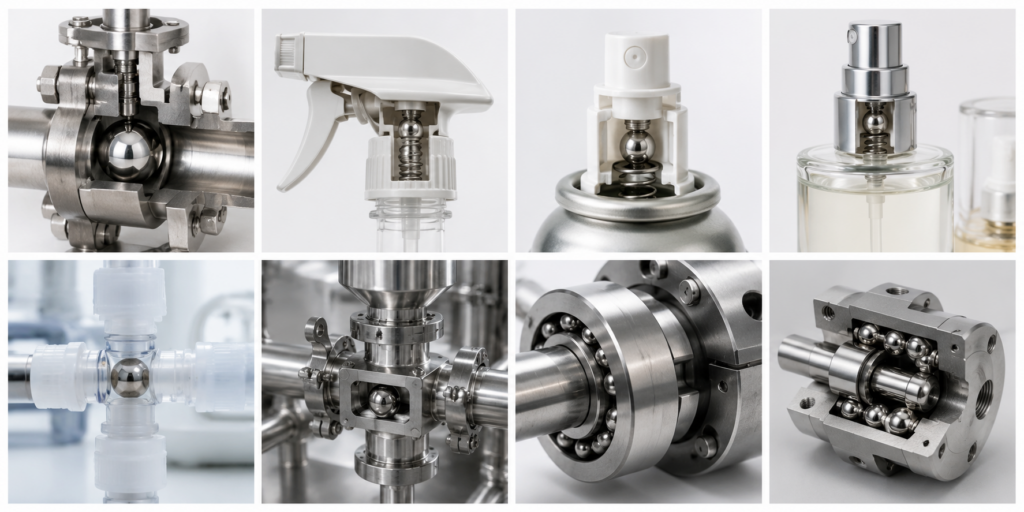
Las bolas de acero inoxidable AISI 302/304/304L se utilizan ampliamente en aplicaciones donde la resistencia a la corrosión, la apariencia limpia, el funcionamiento suave y el suministro estable son más importantes que una alta resistencia a la fatiga en rodamientos.
| Solicitud | Nivel de ajuste | Por qué encaja | Nota para el comprador |
| Bombas y válvulas de retención | Muy bueno | El acero inoxidable austenítico permite un funcionamiento limpio y resistencia a la corrosión en muchos sistemas de manejo de fluidos. | Confirmar la compatibilidad del medio líquido, la temperatura y los productos químicos. |
| Aerosoles, dispensadores y pulverizadores de gatillo | Muy bueno | La buena resistencia a la corrosión y la superficie lisa hacen que estas bolas sean adecuadas para funciones repetidas de accionamiento y sellado. | Confirmar el diámetro de la bola, el acabado superficial y los requisitos de limpieza. |
| Bombas miniatura para perfumes y envases cosméticos | Muy bueno | La apariencia limpia del acero inoxidable y su resistencia a la corrosión se adaptan a los sistemas de dispensación de fragancias, lociones y cosméticos. | Confirmar la compatibilidad con el medio y si se requiere limpieza libre de aceites. |
| Válvulas para aplicaciones médicas | Bien | Adecuadas para muchos componentes de válvulas limpias donde se requiere resistencia a la corrosión y funcionamiento suave. | Confirmar los requisitos normativos, de limpieza y de documentación de inspección. |
| Equipos relacionados con alimentos | Bien | Las bolas de acero inoxidable 304/304L se usan comúnmente donde se requiere facilidad de limpieza y resistencia general a la corrosión. | Confirmar si se requiere documentación de contacto con alimentos o limpieza especial. |
| Rodamientos y acoplamientos especiales | Depende de la aplicación | Útiles en aplicaciones de rodamientos o acoplamientos con cargas bajas a medias y resistentes a la corrosión. | Use 440C o 52100 cuando se requiera alta resistencia a la fatiga o alta dureza. |
| Conjuntos aeroespaciales e industriales de precisión | Depende de la aplicación | Los grados estandarizados de acero inoxidable respaldan una selección controlada en ingeniería. | Confirmar los requisitos de plano, norma, grado e inspección. |
| Entornos con ácido sulfúrico, marinos o ricos en cloruros | Limitado | El 302/304/304L no es la mejor opción para estas condiciones. | Considere 316/316L, 904L, bolas cerámicas o aleaciones especiales resistentes a la corrosión. |
Guía de Selección de Materiales
| Opción de material | Resistencia típica | Limitación | Cuándo recomendar |
| Bolas de acero inoxidable AISI 302 | Buenas propiedades mecánicas, tenacidad y resistencia general a la corrosión. | No se selecciona para máxima dureza; puede mostrar ligero magnetismo después del trabajo en frío. | Pulverizadores, bombas, válvulas, rodamientos especiales y aplicaciones que requieren un comportamiento de acero inoxidable austenítico ligeramente más resistente |
| Bolas de acero inoxidable AISI 304 | El grado austenítico de uso general más común, con apariencia limpia y buena resistencia a la corrosión | No apto para aplicaciones con cloruros fuertes, ácido sulfúrico o de alta dureza | Equipos relacionados con alimentos, válvulas dispensadoras, bombas cosméticas, válvulas para aplicaciones médicas y mecanismos generales resistentes a la corrosión |
| Bolas de acero inoxidable AISI 304L | Menor contenido de carbono que el 304; útil cuando se requiere una especificación de bajo carbono | La resistencia mecánica puede ser inferior a la del 302 en algunos casos; no es una bola de alta dureza | Proyectos que requieren especificación de material 304L, resistencia mejorada a la sensibilización o selección de acero inoxidable de bajo carbono |
| Bolas de acero inoxidable AISI 316/316L | Mejor resistencia a la corrosión en muchos entornos con cloruros y químicos debido al contenido de molibdeno | Costo más elevado que el 304/304L | Entornos marinos, con cloruros, químicos más agresivos, farmacéuticos o de mayor riesgo de corrosión |
| Bolas de acero inoxidable AISI 420C / 440C | Mayor dureza y resistencia al desgaste | Menor resistencia a la corrosión que los grados austeníticos en muchos entornos | Rodamientos, válvulas y conjuntos mecánicos que requieren mayor dureza y resistencia al desgaste |
| Bolas de acero al cromo AISI 52100 | Excelente dureza, precisión y rendimiento de fatiga en rodamientos | No es inoxidable; requiere protección contra la oxidación | Rodamientos de alta precisión, motores, guías lineales y aplicaciones de rodadura de alta carga |
Fabricación y Control de Procesos
SDBALLS controla la producción de bolas de acero inoxidable mediante la selección de materia prima, trefilado, estampación en frío, desbarbado, rectificado o lapeado cuando se requiera, pulido, limpieza, pasivado cuando se especifique, inspección y embalaje de exportación. Para bolas de acero inoxidable AISI 302/304/304L, el control del proceso se centra en la consistencia dimensional, la limpieza superficial, el rendimiento contra la corrosión y la idoneidad para la aplicación, en lugar de en el tratamiento térmico para alta dureza.
La condición superficial es especialmente importante para bombas, pulverizadores, válvulas, envases cosméticos y equipos relacionados con alimentos. SDBALLS puede discutir superficies pasivadas, superficies pulidas, embalaje limpio, entrega libre de aceite, etiquetado especial y planes de inspección personalizados según la aplicación del comprador.
Control de Calidad e Inspección
- Inspección de diámetro y grado según los requisitos de precisión acordados.
- Inspección de redondez, apariencia superficial y defectos para un funcionamiento suave.
- Verificación del material según los requerimientos de AISI 302, AISI 304 o AISI 304L.
- Inspección de dureza cuando lo requiera el plano, la especificación o la orden de compra.
- Confirmación de pasivación y condición superficial cuando se especifique.
- Inspección del embalaje para reducir la contaminación, el riesgo de oxidación, el riesgo de mezcla y los daños durante el transporte.
- Para proyectos OEM, SDBALLS puede discutir la aprobación de muestras, informes de inspección, documentación tipo PPAP, solicitudes RoHS, pruebas de terceros y etiquetado personalizado.
Opciones de Embalaje
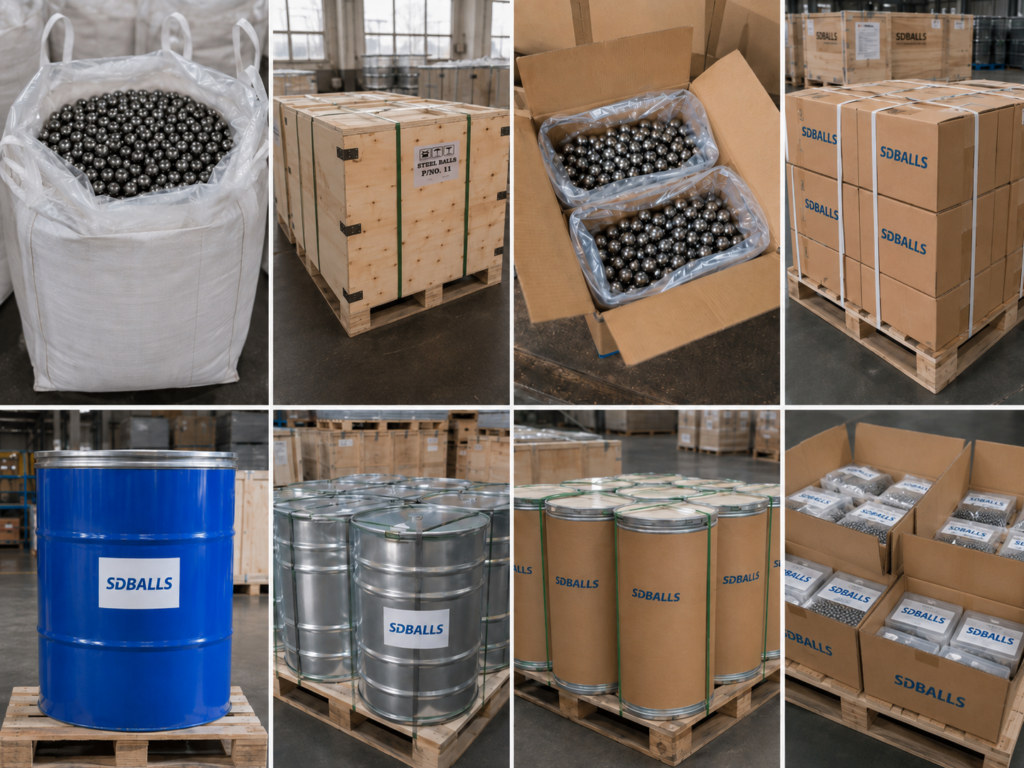
El embalaje puede seleccionarse según la cantidad del pedido, los requisitos de limpieza, el método de transporte de exportación y la aplicación final. Las opciones comunes incluyen bolsas de plástico, cajas de cartón, cubos, bidones, palés y embalajes OEM personalizados. Para aplicaciones médicas, alimentarias, cosméticas y de bombas, los compradores deben confirmar si se requiere embalaje limpio, libre de aceite, con etiquetado de lote separado o embalaje especial anticontaminación.
Cómo Especificar para una Cotización
Para cotizar con precisión, por favor confirme: grado del material (AISI 302, AISI 304 o AISI 304L), diámetro en mm o pulgadas, grado de precisión, requisitos de dureza o magnéticos si son críticos, condición de la superficie, requisito de pasivación, requisito de limpieza, medio de aplicación, cantidad, método de embalaje, documentos de inspección, puerto de destino y término comercial.
Para proyectos de reemplazo, se recomienda a los compradores proporcionar planos, hojas de especificaciones del proveedor actual, fotos, muestras, entorno de aplicación, medios líquidos o químicos, grado requerido y cualquier requisito de prueba especial.
Preguntas frecuentes técnicas
Q: ¿Cuál es la diferencia entre las bolas de acero inoxidable AISI 302, 304 y 304L?
R: AISI 302, 304 y 304L son aceros inoxidables austeníticos. El AISI 304 es el grado de uso general más ampliamente utilizado. El AISI 304L tiene un menor contenido de carbono y se selecciona cuando se requiere una especificación de acero inoxidable bajo en carbono. El AISI 302 puede proporcionar mejores características mecánicas y comportamiento de endurecimiento por trabajo en algunas aplicaciones.
Q: ¿Están endurecidas las bolas de acero inoxidable AISI 302/304/304L?
R: Normalmente se describen como bolas de acero inoxidable austenítico no endurecidas o no templadas en toda su masa. No se endurecen térmicamente como las bolas de acero al cromo 420C, 440C o 52100. La dureza típica está alrededor de HRC 20-39 dependiendo del procesamiento y el trabajo en frío.
Q: ¿Son magnéticas estas bolas de acero inoxidable?
R: El acero inoxidable austenítico es generalmente no magnético en estado recocido, pero el trabajo en frío durante la producción de bolas puede crear una ligera respuesta magnética. Si el magnetismo es crítico, por favor confirme el requisito antes de la cotización.
Q: ¿Son adecuadas las bolas de acero inoxidable 304 para aplicaciones relacionadas con alimentos?
R: Las bolas de acero inoxidable AISI 304 y 304L se utilizan comúnmente en equipos relacionados con alimentos debido a su apariencia limpia y buena resistencia general a la corrosión. El comprador debe confirmar los requisitos exactos de contacto con alimentos, limpieza, pasivación y documentación para el proyecto.
Q: ¿Se pueden utilizar estas bolas en bombas y pulverizadores?
R: Sí. Las bolas de acero inoxidable AISI 302/304/304L se utilizan comúnmente en bombas, válvulas de aerosol, válvulas dispensadoras, pulverizadores hortícolas, pulverizadores domésticos, bombas miniatura para perfumes y válvulas para aplicaciones médicas. Siempre se debe confirmar la compatibilidad con los medios.
Q: ¿Son resistentes las bolas AISI 302/304/304L al ácido sulfúrico o al agua de mar?
R: No son la opción preferida para ácido sulfúrico, agua de mar, entornos con alto contenido de cloruros o químicos agresivos. Las bolas de AISI 316/316L, 904L, cerámica u otros materiales especiales resistentes a la corrosión pueden ser más adecuados.
Q: ¿Cuándo debería elegir bolas de acero inoxidable 304 en lugar de las de 440C?
R: Elija 304 o 304L cuando la resistencia a la corrosión, la limpieza y la tenacidad sean más importantes que una alta dureza. Elija 440C cuando se requiera mayor dureza, resistencia al desgaste y rendimiento en rodamientos, y el entorno corrosivo no sea demasiado agresivo.
Q: ¿Qué información necesita SDBALLS para cotizar?
R: Por favor proporcione el grado del material, diámetro, grado de precisión, cantidad, aplicación, condición de la superficie, requisito de pasivación, método de embalaje, requisito de documentos de inspección, destino y término comercial. Los planos o muestras son útiles para proyectos de reemplazo.
Productos relacionados
- bolas de acero inoxidable
- bolas de acero inoxidable 316/316L para mayor resistencia a la corrosión
- bolas de acero inoxidable 420C para mayor dureza
- bolas de acero inoxidable 440C para rodamientos de precisión
- Bolas de acero al cromo AISI 52100
- Control de calidad SDBALLS
- aplicaciones de bolas de acero inoxidable
Solicitud de programación
Contáctanos hoy para cualquier servicio. (*) Indica campos obligatorios.